Tibetan Dies in Self-Immolation in China's Qinghai Province
A Tibetan woman offers prayer upon her arrival to an event organized to express solidarity with the victims of violence in Tibet and to those who self-immolated to protest against Chinese rule in Tibet, in Kathmandu, November 17, 2012.
Tibetan sources told VOA that a Tibetan man has died after setting himself on fire near a monastery to protest Chinese rule in the western province of Qinghai.
The sources with contacts in the region said 25-year old Wangchen Norbu self-immolated late Monday in Xunhua county in Qinghai's Haidong prefecture. They said he shouted slogans calling for the return of Tibet's exiled spiritual leader, the Dalai Lama, and demanding freedom for the Tibetan people.
The sources said bystanders took Norbu's body to the nearby monastery and gathered to recite prayers.They said the situation was tense with Chinese paramilitary forces surrounding the area.
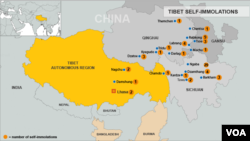
Tibetan Self-Immolations, Through November 20, 2012
Monday's incident is the15th self-immolation protest in Qinghai this month, which coincided with the ruling Chinese Communist Party's once-in-a-decade leadership transition. Some activists say the protests may be an attempt to send a message to the new Chinese leadership.
The latest incident also raises the number of Tibetans who have self-immolated in similar protests to 77 since 2009, with 63 cases known to have resulted in death.
Many Tibetans accuse the Chinese government of repressing their religion and culture. China says Tibetans enjoy religious freedom and benefit from better living standards linked to Chinese investment in underdeveloped Tibetan regions.
Beijing has accused the Dalai Lama of inciting the self-immolations to promote Tibetan separatism. He has said China must conduct a "serious investigation" into the self-immolations rather than placing the blame on him.
The Voice of America provides news and information in more than 40 languages to an estimated weekly audience of over 326 million people. Stories with the VOA News byline are the work of multiple VOA journalists and may contain information from wire service reports.