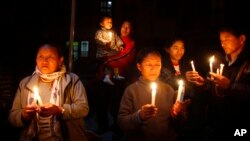
A Tibetan monk who set himself on fire in Nepal's capital, apparently to protest Chinese rule, has died of his injuries.
Hospital staff and police in Kathmandu say the man, in his early 20's, died Wednesday, just hours after setting himself alight near a prominent Buddhist religious site.
Sudip Pathak with the Human Rights Organization of Nepal - one of the only people allowed to visit the protester's hospital room - told VOA the still unidentified monk suffered burns on 96 percent of his body.
He is the 101st Tibetan to self-immolate as part of a four-year protest campaign against Chinese rule in Tibet.
On Wednesday, sources inside China told VOA's Tibetan Service the 100th victim was a 37-year-old monk from the Kirti Monastery in Ngaba, or Aba in Chinese. He is believed to have died on February 3 after setting himself alight in a small town.
Many of the initial self-immolation protests took place in that area and the resulting crackdown by Chinese authorities has delayed information about the situation.
The latest self-immolation in Kathmandu was apparently timed to coincide with the important Tibetan New Year festival of Losar. Tibet's government in exile had asked Tibetans to show solidarity with Tibetans inside China by not celebrating the holiday.
Some eyewitnesses say the protester was chanting anti-China slogans before police and other locals rushed in to put out the flames.
The self-immolation campaign began in February, 2009, to protest what some Tibetans say is Chinese repression of their culture. China denies the charges and says the suicide protests are acts of terrorism.
In the last two months, Beijing has criminalized acts of self-immolation and targeted those accused of inciting them, imposing long jail terms and using financial incentives to encourage the work of informants. The crackdown also targets individuals that authorities say have sent videos or photographs of such acts to contacts outside China.
More than 20,000 Tibetan exiles are living in Nepal, after a failed 1959 uprising against Chinese rule. Nepal has prohibited demonstrations by Tibetan exiles and cracked down on such gatherings in recent years, to avoid angering China.
Hospital staff and police in Kathmandu say the man, in his early 20's, died Wednesday, just hours after setting himself alight near a prominent Buddhist religious site.
Sudip Pathak with the Human Rights Organization of Nepal - one of the only people allowed to visit the protester's hospital room - told VOA the still unidentified monk suffered burns on 96 percent of his body.
He is the 101st Tibetan to self-immolate as part of a four-year protest campaign against Chinese rule in Tibet.
On Wednesday, sources inside China told VOA's Tibetan Service the 100th victim was a 37-year-old monk from the Kirti Monastery in Ngaba, or Aba in Chinese. He is believed to have died on February 3 after setting himself alight in a small town.
Many of the initial self-immolation protests took place in that area and the resulting crackdown by Chinese authorities has delayed information about the situation.
The latest self-immolation in Kathmandu was apparently timed to coincide with the important Tibetan New Year festival of Losar. Tibet's government in exile had asked Tibetans to show solidarity with Tibetans inside China by not celebrating the holiday.
Some eyewitnesses say the protester was chanting anti-China slogans before police and other locals rushed in to put out the flames.
The self-immolation campaign began in February, 2009, to protest what some Tibetans say is Chinese repression of their culture. China denies the charges and says the suicide protests are acts of terrorism.
In the last two months, Beijing has criminalized acts of self-immolation and targeted those accused of inciting them, imposing long jail terms and using financial incentives to encourage the work of informants. The crackdown also targets individuals that authorities say have sent videos or photographs of such acts to contacts outside China.
More than 20,000 Tibetan exiles are living in Nepal, after a failed 1959 uprising against Chinese rule. Nepal has prohibited demonstrations by Tibetan exiles and cracked down on such gatherings in recent years, to avoid angering China.