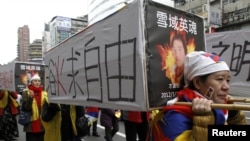
The London-based rights group Free Tibet says a Tibetan nomad in central China has become the third person this week to set himself on fire to protest Chinese rule.
Free Tibet Director Stephanie Brigden says the 24-year-old man, named Jopa, set himself on fire Friday in the township of Meruma in Aba county in the southwest province of Sichuan.
"We know based on witness evidence that the public security bureau attended very quickly and extinguished the flames and took Jopa away. We don't know what his whereabouts are now or whether he has survived his act of self-immolation. But people reported that he was very seriously injured and might not survive," Brigden added.
Brigden says that Chinese military and security forces reportedly deployed into the town shortly after the self-immolation.
Nearly 50 Tibetans have set themselves on fire over the past three years, as Tibetans grow increasingly frustrated about what they see as the Chinese government's limitations on their religion and culture - a charge Beijing denies.
Earlier this week, Free Tibet reported that the mother of two young children died after setting herself on fire outside Tso Monastery in Gansu province. A 21-year-old monk from Kirti Monastery in Sichuan province also reportedly self-immolated, but is believed to have survived.
Brigden says the self-immolation protests show that Tibetans are taking "very serious risks" to share information about their plight with the outside world. She says there is little doubt it is affecting the Chinese leadership.
"China is very sensitive to bad P.R. [public relations]," she said. "It has spent a very long time to improve it's P.R. record with the global community," she said. "And obviously the fact that Tibetans have no other recourse than to set themselves on fire is a very, very bad P.R. strategy."
The Chinese government has described the self-immolations as barbaric and terrorist acts. It accuses overseas groups and the Dalai Lama of inciting separatism. Beijing also has portrayed those who have set themselves on fire as outcasts and criminals.
Free Tibet Director Stephanie Brigden says the 24-year-old man, named Jopa, set himself on fire Friday in the township of Meruma in Aba county in the southwest province of Sichuan.
"We know based on witness evidence that the public security bureau attended very quickly and extinguished the flames and took Jopa away. We don't know what his whereabouts are now or whether he has survived his act of self-immolation. But people reported that he was very seriously injured and might not survive," Brigden added.
Brigden says that Chinese military and security forces reportedly deployed into the town shortly after the self-immolation.
Nearly 50 Tibetans have set themselves on fire over the past three years, as Tibetans grow increasingly frustrated about what they see as the Chinese government's limitations on their religion and culture - a charge Beijing denies.
Earlier this week, Free Tibet reported that the mother of two young children died after setting herself on fire outside Tso Monastery in Gansu province. A 21-year-old monk from Kirti Monastery in Sichuan province also reportedly self-immolated, but is believed to have survived.
Brigden says the self-immolation protests show that Tibetans are taking "very serious risks" to share information about their plight with the outside world. She says there is little doubt it is affecting the Chinese leadership.
"China is very sensitive to bad P.R. [public relations]," she said. "It has spent a very long time to improve it's P.R. record with the global community," she said. "And obviously the fact that Tibetans have no other recourse than to set themselves on fire is a very, very bad P.R. strategy."
The Chinese government has described the self-immolations as barbaric and terrorist acts. It accuses overseas groups and the Dalai Lama of inciting separatism. Beijing also has portrayed those who have set themselves on fire as outcasts and criminals.