



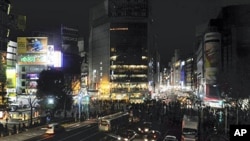
The 35 million inhabitants of Tokyo and its surroundings are getting prepared for enforced power cuts that could last until the end of April. The government says damage and closures at many of the country’s power plants following Friday’s massive earthquake means electricity supplies cannot keep up with demand. Meanwhile authorities are warning of the risk of large aftershocks in the coming days.
Most Monday evenings, Tokyo station is normally packed as millions of commuters head to the suburbs.
It appears many workers have heeded the Japanese government’s call for people to stay home, in an effort to conserve power.
For those who did venture out – the sense of fear following Friday's massive earthquake is still present.
"It is very scary. I am scared of more earthquakes," says one commuter.
"I was in my office on the 33rd floor when the earthquake struck on Friday. It swayed from side to side, everyone was so shocked," says another traveller.
Rolling power outages have been ordered in Tokyo and nine surrounding prefectures.
With electricity output slashed as power stations shut down, the government says it can only supply about three-quarters of normal demand. The cuts could last until the end of April – a big blow to one of the world’s biggest financial hubs.
But the government warns the alternative is a devastating all-out blackout. And the danger is not over.
Japan’s Meteorological Agency says there is a 70 percent chance of a magnitude-seven or stronger earthquake striking in the next three days – and a 50 percent chance in the three days after that. Any big aftershocks could present a danger for buildings already weakened by last Friday’s quake.
State-of-the-art design meant Tokyo’s countless skyscrapers withstood the huge tremors on Friday.
In this huge metropolitan area of 35 million inhabitants, there is a palpable nervousness over what the coming days may bring.
As Tokyo’s workers head home – their thoughts are also with the tens of thousands of people a few hundred kilometres further north, whose homes and livelihoods have crumbled or been washed away.
Raw video of Friday's tsunami