



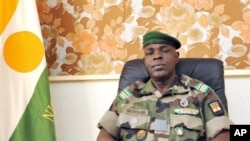
A spokesman for Niger’s military government says, the junta is committed towards returning the country to democratic rule.
Colonel Abdoul Karim Goukoye says the military government expects the National Transitional Council to present its report this week to the administration.
“We are waiting for them by Tuesday. They will forward this project to the prime minister, who will again forward this process to us. Then we will take the last decision. So we are right at this point,” he said.
Last week, Niger’s National Transitional Council reportedly proposed to hold the first presidential election on December 26 of this year following the recent overthrow of long-time President Mamadou Tandja. Ex-President Tandja is currently being held by the military government.
The Supreme Council for the Restoration of Democracy (CSRD) toppled Mr. Tandja after the former leader amended the constitution and removed term limits.
The opposition described the move as a coup d’état and initially refused to cooperate with Mr. Tandja’s government. The international community, including the Economic Community of West African States (ECOWAS) and the African Union, also condemned the move as undermining Niger’s fledgling democracy.
Spokesman Goukoye said the military junta’s mission is to restore Niger’s democracy.
“We are very convinced of let’s say our mission, and we are setting everything (up) to make sure we will restore this democracy in very good terms,” Goukoye said.
Recently the junta signed two ordinances that will prevent all traditional rules or chiefs as well as members of the transitional government from participating in future elections in Niger.
Goukoye said the military government will not cling to power.
“We issued this ordinance saying that no one of us will be allowed to present himself to the next elections….talking about the military even if this person retires or decides to take a period of availability, he will not be eligible for the election. This is pretty much clear,” Goukoye said.
He also said that the National Transitional Council will propose a period and agenda after which the junta will make a final decision on when to hand over power to an elected government.