Trade Barriers Thwart African Food Production, Warns World Bank
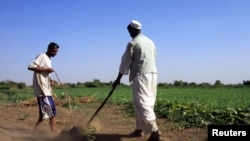
Sudanese farmers prepare their land for agriculture on the banks of the river Nile in Khartoum, November 2009 file photo.
Development experts say large regional markets could boost Africa’s food production and improve efficiency by providing economies of scale.
But a number of trade barriers and restrictions are holding that dream in check. They keep the cost of food high for consumers and the price of yield-boosting fertilizers and seeds beyond the reach of small farmers. The World Bank says among those worse affected are landlocked countries like Burundi, Malawi, Zambia and Uganda, where prices may be 20 times higher than coastal states.
"At the moment," he says, "most countries in Africa have their own national policies towards seeds, and they want to make sure that they test new seeds very carefully in their local conditions before they will allow them to be released. [This] despite the fact that another country with very similar agronomic conditions may have already implemented those tests. So, what you get is a very segmented market for seeds. Farmers end up paying more and must wait much longer for seeds than farmers elsewhere in the world before they get higher-yielding seeds."
The situation is similar for fertilizers, which cost more in sub-Saharan Africa than anywhere in the world. One problem, Brenton says, is that suppliers often make blends according to the specifics of small areas of their countries. Those blends would be less expensive if there were economies of scale, including other countries with similar conditions where the same fertilizer could be sold.
Standards and regulations
The World Bank report offers possible solutions to improving cross border trade and removing barriers.
Some countries are working to harmonize regional standards on inputs and foods, so both can be widely traded, often at a lower cost.
Brenton says standards should include the needs of all farmers, large and small. He notes that they may be different for small farmers interested in selling locally or regionally and farmers who want to export to the United States and Europe.
Brenton says there’s also an alternative to harmonization:
"You recognize that two countries are trying to achieve the same objective, but they may be doing it in a slightly different way with slightly different standards," he explains. "The regulatory regimes are achieving the same objective… so you recognize that the standards , the approaches are equivalent… If the food satisfies one country’s standards, then it doesn’t have to be retested again when it goes into the other country."
Some regional bodies are taking action to coordinate standards and to clear hurdles to cross border trade.
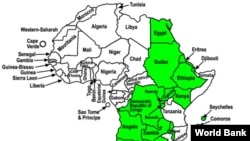
Map of COMESA (World Bank)
For example, the Common Market for Eastern and Southern Africa, COMESA, is working to harmonize seed regulations for 13 crops: maize, rice, groundnuts, cotton, beans, cassava, wheat, potato, sunflower, soya beans, millet and cassava.
It’s also working to create a so-called Green Pass. The document would ensure that foods coming from areas that have been cleared of problems that could affect human health are able to travel from one country to another without being certified each time they cross the border.
Map of SADC (World Bank)
The Southern African Development Community has created a policy to make it easier to trade seeds.
"If two members of SADC approve a seed for release, then it should be freely available in all SADC countries," says Brenton. "That’s a positive way in overcoming that you need regulatory oversight to make sure these seeds are effective and that farmers will be getting seeds that are useful… but without every country getting wound up in its own rules and regulations."
Besides regulations on inputs, other factors are also preventing broader cross-border trade.
Women traders
Among them are multiple roadblocks and checkpoints where bribes must be paid before proceeding. Often targeted are women, who make up the majority of cross-border traders. Many are subject to verbal and physical harassment and even rape.
COMESA is considering one solution to the problem: a charter of small traders that would urge governments to stop the harassment and extortion. One proposal under discussion would include a reduction in the number of male officials and agency representatives at the border.
Other customs reforms include the introduction in East Africa last year of a common software platform allowing officials to communicate more easily across borders.
Road to success
Todd Amani, a senior deputy assistant administrator for Africa at USAID, told a recent seminar at the Washington-based think tank, the Wilson Center, that the reforms reduced the time it takes to transports goods along the Mombasa-Kigali trade corridor by five days, and reduced the cost of trading goods in the East Africa region by two percent despite a 20 percent fuel rise in that same year.
High transportation costs also affect the efficient trade of goods between African countries.
Contributing to the problem are cartels which discourage competition in and modernization of the trucking industry. The Bank says by liberalizing the sector, Rwanda was able to lower the cost of transport and boost agricultural production. And, the new Bank report cites one study indicating that a 50 percent drop in transport costs would increase agricultural GDP in Mozambique by seven percent, but also lead to a rise in neighboring Malawi by about half that amount [3 percent].
Meanwhile, a U.S. Government initiative is also working to improve cross border trade. USAID’s Todd Amani says his agency has helped introduce trade hubs in West, Southern and East Africa: Accra, Ghana; Gabarone, Botswana; and Nairobi, Kenya.
He says reforms backed by the Southern Africa hub have contributed to a 12-fold increase in the use of the Trans-Kalahari Corridor, a highway linking Namibia and Botswana with South Africa. In addition, travel time has also been reduced from 72 to 48 hours.
That’s good news for businessmen and traders, who need less time to transport food from productive areas of the region to ones in need of food. Experts also say that movement of goods will become more important in the future, as climate change brings drought to some areas, but improved growing conditions to others.