


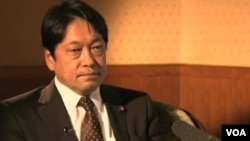
Here is the transcript of an exclusive interview by VOA's Steve Herman with Japanese Defense Minister Itsunori Onodera in Tokyo.
VOA: As you know, North Korea has confirmed that it carried out a third nuclear test today. This had been widely expected. From your viewpoint as defense minister, how does this affect Japan?
Onodera: North Korea has announced their nuclear test succeeded. I think this means a big threat, not only to Japan, but also to the East Asia region, as a whole. North Korea has also managed to develop an improved version of the “Taepodong-2” - a long-range ballistic missile - last December. Therefore this nuclear threat is not only a concern for Japan, but also the world.
VOA: But, specifically, what concerns do you have as the Japanese defense minister about this for Japan's security?
Onodera: Because North Korea has conducted such a provocative action, we need to bolster our country’s defense system to face this kind of threat. But due to our [pacifist] constitution, our country is in a very restricted situation when it comes to having nuclear weapons, as well as increasing our [conventional] forces. Therefore, it is very important to strengthen the U.S.-Japan security alliance.
VOA: As a lawmaker for many years, in your party, you have been involved in foreign affairs. As a response to this we're hearing talk about more sanctions - from Japan, from South Korea, from the United Nations. But sanctions obviously have not prevented North Korea from launching these rockets and carrying out three nuclear tests now. Is there something that needs to be done beyond sanctions?
Onodera: Placing a heavy tax [by China] on North Korea would be the most effective sanction. China has the strongest economic connection with North Korea, but it has been reluctant about many sanctions in the past. But we saw that prior to this test even China joined in the harsh U.N. resolution against North Korea. Yet North Korea with this action has even betrayed that resolution. So I think the first step is to strengthen sanctions and I am expecting to see more effective sanctions.
VOA: Speaking of China, Japan has its own security issues with China. They are denying Japan's claim that its fire locked-on radar 'painted' a Japanese ship. What evidence can you release to verify that this indeed happened, which China denies?
Onodera: If we release that information in detail our intelligence-gathering ability will be revealed to another country, so I am cautiously debating this within the government. That said, in realistic term, the actual use of fire-control radar clearly occurred and we have a number of records and data, in this case, including transmissions that are specific [to this kind of radar].
Also, the U.S. supports our contention. The U.S. defense secretary as well as the [State Department] press secretary the other day, supported the view that Japan’s assertion was indeed, correct.
I feel we need to clearly state this issue to our ally, the United States, and also to the international community. But more importantly, we have to avoid a big conflict and actually we have a maritime communications mechanism between Japan and China. When an incident like this happens, we are supposed to negotiate with a hotline. Or we are supposed to be able to communicate between vessels and fleets or between vessels and airplanes. That is what we want to have [with China].
Japan has already urged China to restart talks to establish these communications mechanisms through diplomacy. It is very important for the two nations to exchange and share information, in order to avoid such incidents.
VOA: Have you had any response from Beijing about this hotline idea?
Onodera: China and Japan basically reached an agreement about this a few years ago. We already had working-group level meetings a few times on how we would work out specifics, but this has not taken place since last fall. So we are suggesting to re-start the talks, but we have not heard anything yet from China, but that is the process we desire.
VOA: Some analysts believe that China may have been trying to provoke in this incident that happened with the radar for the Japanese forces to fire first. Do you believe that might have been the case, and how worried are you that your forces may not be able to restrain themselves if this type of thing does happen again?
Onodera: We have many capabilities. Whatever China’s intention was, it is our duty to protect our land, territory and airspace. So we will firmly enhance our level of ability and we are continuing to increase it.
VOA: As you mentioned, Japan faces constitutional restrictions on what it can do with its self-defense forces as they are called. And you're heavily reliant on U.S. forces being under the U.S. nuclear umbrella. Based on the challenges that you are facing in this job and your country is facing right now from potential hostilities in the region, is it enough to rely on the status quo with the U.S. forces? Or would you like to see something change as far as the alliance or the composition of Japanese forces?
Onodera: I think military power should be flexible in order to respond on a case-by-case basis regarding opposing threats. We have been facing bigger threats recently. For example, North Korea's missiles and nuclear weapons, China's enhanced military power and its increasing defense budget, as well as enhancements being made by other surrounding countries. Change is happening around us. And besides actual military power, there are new kind of threats emerging, including cyber or from space. In order to respond to such threats we are reviewing our defense system and also we are in the process of revising U.S.-Japan guidelines, as well as to be prepared for new kinds of threats.
VOA: This interview, your words, will be seen and heard in China, in North Korea. These are places which were former colonies of Japan. And Japan is not seen as a victim there. It's seen as a past aggressor and a potential future aggressor. Is there anything you'd like to say to people in China, in North Korea about Japan's military?
Onodera: Japan always seeks peace in line with its constitution and the Japanese people hold the same view. What we are trying to do is to merely defend the country to protect our lives and property. That is what we are focused on and are building our defenses accordingly. I think Japan’s stance on this will never change.
VOA: Mr. Onodera, thank you very much for your time today.
VOA: As you know, North Korea has confirmed that it carried out a third nuclear test today. This had been widely expected. From your viewpoint as defense minister, how does this affect Japan?
Onodera: North Korea has announced their nuclear test succeeded. I think this means a big threat, not only to Japan, but also to the East Asia region, as a whole. North Korea has also managed to develop an improved version of the “Taepodong-2” - a long-range ballistic missile - last December. Therefore this nuclear threat is not only a concern for Japan, but also the world.
VOA: But, specifically, what concerns do you have as the Japanese defense minister about this for Japan's security?
Onodera: Because North Korea has conducted such a provocative action, we need to bolster our country’s defense system to face this kind of threat. But due to our [pacifist] constitution, our country is in a very restricted situation when it comes to having nuclear weapons, as well as increasing our [conventional] forces. Therefore, it is very important to strengthen the U.S.-Japan security alliance.
VOA: As a lawmaker for many years, in your party, you have been involved in foreign affairs. As a response to this we're hearing talk about more sanctions - from Japan, from South Korea, from the United Nations. But sanctions obviously have not prevented North Korea from launching these rockets and carrying out three nuclear tests now. Is there something that needs to be done beyond sanctions?
Onodera: Placing a heavy tax [by China] on North Korea would be the most effective sanction. China has the strongest economic connection with North Korea, but it has been reluctant about many sanctions in the past. But we saw that prior to this test even China joined in the harsh U.N. resolution against North Korea. Yet North Korea with this action has even betrayed that resolution. So I think the first step is to strengthen sanctions and I am expecting to see more effective sanctions.
VOA: Speaking of China, Japan has its own security issues with China. They are denying Japan's claim that its fire locked-on radar 'painted' a Japanese ship. What evidence can you release to verify that this indeed happened, which China denies?
Onodera: If we release that information in detail our intelligence-gathering ability will be revealed to another country, so I am cautiously debating this within the government. That said, in realistic term, the actual use of fire-control radar clearly occurred and we have a number of records and data, in this case, including transmissions that are specific [to this kind of radar].
Also, the U.S. supports our contention. The U.S. defense secretary as well as the [State Department] press secretary the other day, supported the view that Japan’s assertion was indeed, correct.
I feel we need to clearly state this issue to our ally, the United States, and also to the international community. But more importantly, we have to avoid a big conflict and actually we have a maritime communications mechanism between Japan and China. When an incident like this happens, we are supposed to negotiate with a hotline. Or we are supposed to be able to communicate between vessels and fleets or between vessels and airplanes. That is what we want to have [with China].
Japan has already urged China to restart talks to establish these communications mechanisms through diplomacy. It is very important for the two nations to exchange and share information, in order to avoid such incidents.
VOA: Have you had any response from Beijing about this hotline idea?
Onodera: China and Japan basically reached an agreement about this a few years ago. We already had working-group level meetings a few times on how we would work out specifics, but this has not taken place since last fall. So we are suggesting to re-start the talks, but we have not heard anything yet from China, but that is the process we desire.
VOA: Some analysts believe that China may have been trying to provoke in this incident that happened with the radar for the Japanese forces to fire first. Do you believe that might have been the case, and how worried are you that your forces may not be able to restrain themselves if this type of thing does happen again?
Onodera: We have many capabilities. Whatever China’s intention was, it is our duty to protect our land, territory and airspace. So we will firmly enhance our level of ability and we are continuing to increase it.
VOA: As you mentioned, Japan faces constitutional restrictions on what it can do with its self-defense forces as they are called. And you're heavily reliant on U.S. forces being under the U.S. nuclear umbrella. Based on the challenges that you are facing in this job and your country is facing right now from potential hostilities in the region, is it enough to rely on the status quo with the U.S. forces? Or would you like to see something change as far as the alliance or the composition of Japanese forces?
Onodera: I think military power should be flexible in order to respond on a case-by-case basis regarding opposing threats. We have been facing bigger threats recently. For example, North Korea's missiles and nuclear weapons, China's enhanced military power and its increasing defense budget, as well as enhancements being made by other surrounding countries. Change is happening around us. And besides actual military power, there are new kind of threats emerging, including cyber or from space. In order to respond to such threats we are reviewing our defense system and also we are in the process of revising U.S.-Japan guidelines, as well as to be prepared for new kinds of threats.
VOA: This interview, your words, will be seen and heard in China, in North Korea. These are places which were former colonies of Japan. And Japan is not seen as a victim there. It's seen as a past aggressor and a potential future aggressor. Is there anything you'd like to say to people in China, in North Korea about Japan's military?
Onodera: Japan always seeks peace in line with its constitution and the Japanese people hold the same view. What we are trying to do is to merely defend the country to protect our lives and property. That is what we are focused on and are building our defenses accordingly. I think Japan’s stance on this will never change.
VOA: Mr. Onodera, thank you very much for your time today.