



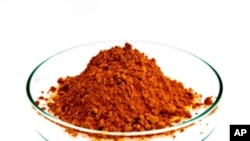
Turmeric doesn't just add a little spice to your food, it could also give your brain a jolt. Researchers find that the widely used spice might contain compounds which can help prevent neurological diseases.
Many medicines have come from nature. Both aspirin and quinine were derived from the bark of trees while digitalis, a potent heart medicine, comes from a flower. Researcher Dave Schubert from the Salk Institute in San Diego has been looking at turmeric, a spice that's commonly used, particularly in South Asia.
"If you look at the epidemiology of Alzheimer's in India, and compare that to other countries, India has much lower levels of Alzheimer's than other countries," says Schubert.
He and other researchers believe that part of the reason for that low level of brain injury in India is that, over a lifetime, consuming turmeric may actually have a protective effect on the brain and nervous system. It's not an easy hypothesis to prove, but Schubert began by extracting several compounds from the spice. He found that at least one compound, curcumin, has protective effects on brain cells of lab animals with neurological injuries.
That's probably because, rather than working directly on brain cells, curcumin targets many parts of the body, which is typical of medicines that come from nature.
"So they are antioxidants. They affect inflammation," says Schubert. "And so it's not probably one thing that's happening when you eat something like curcumin, it's multiple things and these things are probably either additive or they multiplied together."
He believes it's possible that, eventually, curcumin and other compounds from turmeric could be used to actually protect the brain from traumatic brain injury, stroke or even Alzheimer's.
"The thought is that you can give people something like curcumin derivative or some drug before they are exposed to the concussion and the injuries, and that may prevent it or lessen the effect," says Schubert. "So prevention is certainly a major aspect."
Schubert has collaborated with scientists in several labs, and they have several research papers in publication. He's trying to get the attention of drug-makers or the military in moving forward to create a medicine from turmeric. In the meantime, he says, it doesn't hurt to add some to your diet.