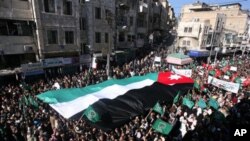



Demonstrators in Jordan say they are preparing for more protests. Massive demonstrations inspired by unrest in Tunisia have shaken what historically has been one of the most stable nations in the Middle East and raised questions about the future role of the country's popular monarch.
Some protesters in last Friday's demonstration waved pieces of bread.
It is rising food prices, unemployment, and anger over corruption that prompted thousands to take to the streets of Amman last week.
One of them was 28-year-old Sufian Sabri el Euheide, who lives at the Baqa'a Palestinian refugee camp outside Amman.
El Euheide is a day laborer who spends many of his days going through newspapers, looking for a permanent job to support his wife and two children. He blames what he says is a corrupt system for his problems.
He says he works for two weeks and sits for another two weeks, trying to find odd jobs in construction.
Like many of the protesters, he is encouraged by events in Tunisia.
He says he liked what he saw in Tunisia, where he said the will of the people brought about changes.
El Euheide and other demonstrators say they do not seek a revolution, but want political reforms. They say they want to be able to elect their prime minister, rather than have someone appointed by King Abdullah.
It is a rare challenge to a political system dominated by the king, who rules as an absolute monarch with the power to elect ministers, rule by decree and dismiss parliament.
The king remains popular and many protesters say their actions are not against him, but against the system over which he presides.
The demonstrations have drawn various segments of society, including left-wing activists and Islamists whose relations with the monarchy have become more strained.
Hamza Mansour heads the Islamic Action Front, the political wing of the Muslim Brotherhood in Jordan. He has been among those leading the calls for democratic reforms, which he says should bring about a gradual transformation in Jordan.
Mansour says his message is that there should be reforms, a democratic state, and a redistribution of power. He says the goal of his movement is to end corruption, including what he calls "moral corruption."
The protests have taken place with government approval and protesters say they intend to keep the demonstrations peaceful.
Sufian Sabri el Euheide says there are some parallels to Tunisia in regard to unemployment and corruption, but he says Jordan's decision to allow protests makes this situation, at least for now, different.
El Euheide says Jordan is different from Tunisia, which he says was a dictatorship. He says that here, people are given an outlet to protest. That, he says, allows there to be hope for peaceful change.
The Jordanian government has taken emergency measures to quell the unrest, including pay raises for public servants and a drop in the prices of basic goods.
For now by many accounts, the king's popularity is not in question. However, analysts say that could change quickly.
Nahid Hattar is a commentator with the newspaper Al Arab Al Youm. He says the outcome of the protests will depend on the king himself. He says that if the king responds to the demands of the people in a meaningful way and deals effectively with corruption, the matter will be resolved.
Hattar says the palace now has an opportunity to make a difference, which, he says, could be "the one before the last."
Tunisia Unrest Inspires Jordan Protesters
- By Luis Ramirez