


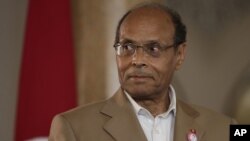
PARIS — Tunisia's President Moncef Marzouki is in France, in a new drive to repair relations with its former colonial power. Marzouki also will be seeking closer business ties that are key to turning around his country's ailing economy.
Tunisians have not forgotten France's longtime support for the regime of former dictator Zine el-Abidine Ben Ali. Or that former French foreign minister Michele Aliot-Marie last year offered help to Tunisian police cracking down on pro-democracy demonstrators.
But experts like Steven Ekovich, political science professor at the American University of Paris, say the three-day visit of Tunisian President Moncef Marzouki marks a new page in Tunisian-French relations.
"He's here to… reignite positive relations," said Ekovich. "Tunisia needs good relations with France - it's unavoidable. The primary European partner of Tunisia is France. Tunisia can't do without France. Good relations are absolutely necessary."
This is not the first high-level visit here since Tunisia's 2011 revolution. The country's interim prime minister attended last year's G8 meeting in Normandy to seek international assistance. Prime Minister Hamadi Jabali, of the leading Islamist Ennahda party, has also visited.
But it helps that Marzouki will be starting over with a new French government. He holds talks with President Francois Hollande and other top officials - including the mayor of Paris, Bertrand Delanoe, who was born in Tunisia. Besides politics, economics are certain to be up for discussion as Tunisia continues to battle high unemployment and a sluggish economy.
France is a leading investor in the North African nation, with about 1,200 French companies doing business there. French tourists are also going back, but in fewer numbers than before the revolution.
"The tourists are a little skittish about the security situation," said Steven Ekovich. "And if there's a fear there might be some sort of extremist Islam of course, of course that's not going to help tourism. If French women feel they can't wear their bikinis on the beach, that will dampen tourism as well."
Marzouki was a leading dissident and human rights activist during the Ben Ali years. He has clashed with Prime Minister Jebali, most recently over the extradition of Libya's former prime minister, calling it "illegal."
In a recent interview with Radio France Internationale, Marzouki said that he and Jebali had decided to wipe the slate on the disagreement. He also wants to repatriate state funds that Tunisia says Ben Ali stashed abroad, including in Swiss bank accounts.
Tunisians have not forgotten France's longtime support for the regime of former dictator Zine el-Abidine Ben Ali. Or that former French foreign minister Michele Aliot-Marie last year offered help to Tunisian police cracking down on pro-democracy demonstrators.
But experts like Steven Ekovich, political science professor at the American University of Paris, say the three-day visit of Tunisian President Moncef Marzouki marks a new page in Tunisian-French relations.
"He's here to… reignite positive relations," said Ekovich. "Tunisia needs good relations with France - it's unavoidable. The primary European partner of Tunisia is France. Tunisia can't do without France. Good relations are absolutely necessary."
This is not the first high-level visit here since Tunisia's 2011 revolution. The country's interim prime minister attended last year's G8 meeting in Normandy to seek international assistance. Prime Minister Hamadi Jabali, of the leading Islamist Ennahda party, has also visited.
But it helps that Marzouki will be starting over with a new French government. He holds talks with President Francois Hollande and other top officials - including the mayor of Paris, Bertrand Delanoe, who was born in Tunisia. Besides politics, economics are certain to be up for discussion as Tunisia continues to battle high unemployment and a sluggish economy.
France is a leading investor in the North African nation, with about 1,200 French companies doing business there. French tourists are also going back, but in fewer numbers than before the revolution.
"The tourists are a little skittish about the security situation," said Steven Ekovich. "And if there's a fear there might be some sort of extremist Islam of course, of course that's not going to help tourism. If French women feel they can't wear their bikinis on the beach, that will dampen tourism as well."
Marzouki was a leading dissident and human rights activist during the Ben Ali years. He has clashed with Prime Minister Jebali, most recently over the extradition of Libya's former prime minister, calling it "illegal."
In a recent interview with Radio France Internationale, Marzouki said that he and Jebali had decided to wipe the slate on the disagreement. He also wants to repatriate state funds that Tunisia says Ben Ali stashed abroad, including in Swiss bank accounts.