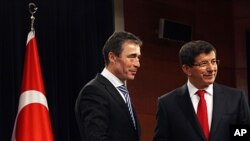



The head of NATO is visiting Turkey to mark the country's 60th anniversary as a member. But the meeting was as much about issues currently facing the military alliance, such as Iran and Afghanistan.
Iran topped the agenda of talks in Ankara between NATO chief Anders Fogh Rasmussen and Turkish Foreign Minister Ahmet Davutoglu. Turkey, which borders Iran, has a radar system operating on its territory as part of NATO's missile defense system. That system is aimed primarily at countering any attack by Tehran. But, as Davutoglu made clear, who will use the radar remains a sensitive subject for Ankara.
Davutoglu said Turkey "will never allow any third country to use any NATO facility." He added that Turkey's position on this will be "even more clear" regarding Israel. Davutoglu said the purpose of the NATO defense system to protect the populations of NATO allies.
Rasmussen concurred, saying NATO would never share such information with third parties. Israel is not a NATO member.
Turkish media were full of reports, citing a U.S. newspaper article, that the U.S. and Israel used data from the Turkish radar for an anti-missile exercise. The missile defense system is politically sensitive for Ankara, both domestically and internationally.
Iran has strongly condemned Turkey for agreeing to participate in NATO defenses. The Turkish government has faced strong criticism from opposition parties, who claim the system is meant to protect Israel, not Turkey or other NATO members.
The ongoing crisis in Syria was also discussed during the NATO chief's meeting with Davutoglu. Rasmussen praised Turkey's role in the wider Arab Spring, citing its unique position as a NATO member bordering the Middle East.
Speculation continues to grow that Ankara could play a role in a possible humanitarian intervention in Syria.
The NATO summit on Afghanistan schedule to take place in Chicago this May was also discussed during Friday's meetings in Ankara. Rasmussen said that helping Afghan forces take responsibility for security will be a key topic at the summit. Turkish forces remain in the forefront of training Afghan police and soldiers.
After Turkey jointed NATO 60 years ago, it played a key role in the Cold War against the then Soviet Union, guarding Europe's southeast flank. Even with the ending of the Cold War, Turkey's importance to NATO appears undiminished.
Turkey Pledges No Third Country Use of NATO Defenses
- By Dorian Jones