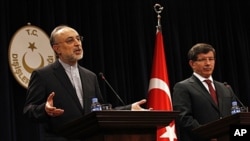
Turkish Foreign Minister Ahmet Davutoglu is in Iran for talks that are expected to address the burgeoning political crisis in neighboring Iraq, where Vice President Tariq al-Hashemi has fled to the semiautonomous Kurdistan region to escape a warrant for his arrest.
Al-Hashemi has taken sanctuary in the disputed northern territory in the wake of charges he led Sunni death squads against Shi'ite opponents -- charges he denies. Iraq's Prime Minister Nouri al-Maliki, a Shi'ite who ordered the arrest warrant, has demanded the Iraqi Kurds hand over Hashemi. They have refused and are instead calling for talks to resolve the crisis.
According to Turkish Foreign Ministry spokesman Selcuk Unal, Ankara strongly backs that stance.
"KRG [the Kurdistan Regional Government] has asked for a national meeting concerning all Iraqi parties to discuss recent developments, and we support that call," he says. "We have good relations with the KRG of Iraq, and we continue to do so. We will be continuing our economic relations and other political and social links."
Analysts say Ankara's strong support for the Kurdistan regional government is also affecting Turkey's deteriorating relationship with Iran. There are growing suspicions in Ankara that Tehran is surreptitiously orchestrating some of the political upheaval in Iraq so as to strengthen Shi'ite power there.
Murat Bilhan, a former Turkish ambassador and professor of international relations at Istanbul's Kultur University, says powerful economic forces are also driving the relationship between Ankara and the Kurdistan government.
The region is believed to have massive energy reserves. And there is trade: Iraqi Kurd leaders say about 60 percent of foreign companies operating in the region are Turkish.
"Turkey has special interests in the Kurdish region, and it has special relations with them," says Bilhan. "We have exchanged visits. They have come to Turkey for advice and to exchange views for future cooperation, so I think we have many things in common."
But Kurdish separatists known as the PKK operating in Turkey often enter the country from bases in Iraqi Kurdistan. Turkish jets regularly bomb the area targeting the separatists, drawing angry responses from the Iraqi Kurdish government.
Soli Ozel, a columnist for the Turkish newspaper Haberturk and professor at Istanbul's Bilgi University, says economic interests ultimately outweigh threats to regional stability from the PKK.
"The Kurds of Iraq said basically they cannot fight against the PKK, but we help you in any other way we can," he says. "And Turkey will have to live with that restriction, but our trade is in billions of dollars, and the logic of geopolitics -- the logic of history, maybe of sociology -- dictates that the Iraqi Kurds will have closer relations than with Arab Iraq."
In his visit to Iran, the Turkish foreign minister is likely to bring up some of the thorny issues concerning neighboring Iraq, and he is likely to reaffirm Turkey's ties with Iraqi Kurdistan.
Turkey to Broach Kurdistan Issue in Tehran
- By Dorian Jones