



News / Europe

Turkish PM Could Seek Constitutional Referendum

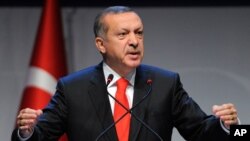
FILE - Turkey's Prime Minister Recep Tayyip Erdogan addresses a forum in Istanbul, Turkey, Oct. 13, 2012. FILE - Turkey's Prime Minister Recep Tayyip Erdogan addresses a forum in Istanbul, Turkey, Oct. 13, 2012.
x
FILE - Turkey's Prime Minister Recep Tayyip Erdogan addresses a forum in Istanbul, Turkey, Oct. 13, 2012.
TEXT SIZE - +
Reuters
Turkish Prime Minister Tayyip Erdogan said on Wednesday he will take proposed constitutional reforms, expected to include the creation of an executive presidency, directly to parliament and if necessary to the people if no deal can be reached by April.
 
A cross-party parliamentary commission drafting a new constitution had been expected to finish its work by the start of this year but has failed to reach a consensus.
 
Erdogan, who has dominated Turkish politics since his AK Party first came to power in 2002, is widely viewed as wanting to change the charter to establish an executive presidency for himself in time for elections due next year.
 
Erdogan said the AK Party would take its proposals for an amended constitution directly to parliament if no agreement had been reached by the end of March.
 
"We are hoping that this matter will be finalized by the end of March ... If it is not completed, the AK Party will bring its work on this to parliament's agenda," he told a meeting of his ruling party deputies in parliament.
 
Approval of constitutional amendments requires two-thirds support in the 550-seat assembly, or 367 votes, which the AK Party, which controls 326 seats, may struggle to achieve.
 
It would need only 60 percent, or 330 votes, for the bill to be put to a referendum, however.
 
"When we have the power to hold a referendum, we will go to the nation," Erdogan said.
 
Politicians from all Turkey's main parties agree Turkey's current constitution, drawn up after a 1980 coup, needs to be revised. But the opposition fears the reforms the AK Party wants will hand Erdogan too much power.
 
The clock is ticking. Local elections are due in March 2014, followed by a presidential vote a few months later and a parliamentary election in 2015.
 
In a long-awaited cabinet reshuffle ahead of that election cycle, Erdogan replaced his interior, tourism, health, and education ministers with close allies last week.

You May Like

Experts Weigh In on Challenges of Closing Guantanamo Prison

Former chief military prosecutor at Guantanamo delivers petition to White House with more than 370,000 signatures, demanding facility be closed down immediately More

Karzai to Discuss Enhancing Defense Ties with India

Afghanistan looking for more military aid as it prepares for withdrawal of NATO forces by next year More

India, China Pledge to Overcome Border Tensions

Indian prime minister and Chinese premier attempt to move past tense standoff in the Himalayas during Delhi talks More

Burmese President Opens US Visit with VOA Town Hall Meeting

Ahead of his meeting with President Obama Monday, Thein Sein answered questions on human rights and economic development in his country More

This forum has been closed.
Comment Sorting
Comments
     
by: Uocul Sidtra from: Turkey
January 30, 2013 4:52 PM
what you failed to mention, in this flimsy article, is that Erdogan's proposal for a constitutional restructuring will make Turkey look like the Taliban.

Featured Videos

Your JavaScript is turned off or you have an old version of Adobe's Flash Player. Get the latest Flash player.
Video

Video US Oil Surge Could Impact Mideast Geopolitics

The United States will account for a third of new oil supplies over the next five years, and will become energy self-sufficient in 20 years, according to a new report by the Paris-based International Energy Agency (IEA). Although U.S. oil imports from Arab Gulf countries increased last year, analysts predict the U.S. will lose its dependence on Middle East imports, which is expected to have a huge impact on international relations and the balance of power. VOA's Henry Ridgewell reports.