News / Middle East

    Bitter Rebels Blame Kurds for Looming Tide of Syrian Refugees

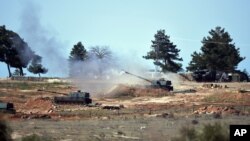
    Turkish artillery fire from the border near Kilis town toward northern Syria, in Kilis, Turkey, Feb. 16, 2016.
    Turkish artillery fire from the border near Kilis town toward northern Syria, in Kilis, Turkey, Feb. 16, 2016.

    Intense fighting in northern Syria, near the Turkish border, has raised sharp concerns that a huge new wave of Syrian refugees will soon be pouring into Turkey.

    Turkish officials and a rebel commander manning a border post fear that Assad regime forces and Kurdish fighters will press their offensive to the Syrian border crossing at Azaz, following major gains on the battlefield overnight in the northern Aleppo countryside.

    Both the Turks and Syrian rebels say that could spark a new wave of refugees to push toward Turkey. With tens of thousands of desperate civilians crowded in camps along the border near Azaz, Turkey may be forced to admit them, and that could attract even more refugees.
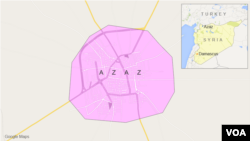
    Turkish officials contend this is a deliberate Kurdish strategy to drive as many Sunni Arab families as possible out of the northern Aleppo countryside. This would allow Kurds to lay claim to the territory as part of their homeland, and the Turks believe this plan has been endorsed by the Assad regime, if only as a wartime tactic.

    Militiamen with the People’s Protection Units, or YPG - the armed wing of the Syrian Kurdish Democratic Union Party (PYD) - took control overnight of Tell Rifaat, a strategic town 15 kilometers from Azaz that overlooks the junction of two main roads leading to Aleppo city. Tell Rifaat sits higher than the surrounding countryside, providing clear firing lines for artillery batteries.

    Pockets of rebel resistance were still reported Tuesday, but the Syrian Observatory for Human Rights, a pro-opposition monitoring group, said the YPG and its allies were in control of Tell Rifaat and the village of Kafr Naseh after heavy clashes with rebel and Islamic factions.

    Regime forces — mainly Iranian, Afghan and Iraqi Shi’ite fighters — also seized control of the villages of Masqan and Ihres overnight. Ihres is an important way station for civilians fleeing territory controlled by the Islamic State.

    A 'calamity'

    The rebel commander overseeing security at the Bab al Samah border crossing said the latest developments are a "calamity."

    In an exclusive interview with VOA Tuesday, Abu Ali Sijjos said without Tell Rifaat, rebel fighters have nowhere to establish a defensive line.

    “All we can do is to form a protective line around the displaced civilians, but the Russians can still attack with their warplanes and the regime would be able to lob mortars over the line,” Ali Sijjos added.
     
    He confirmed that some rebel factions withdrew Tuesday from the town of Mare’, 25 kilometers north of Aleppo, based on American officials' advice to avoid a clash with the approaching YPG. Those Kurdish fighters are now just seven kilometers from the border at Azaz.

    The rebel commander's account of contacts with U.S. officials could not be verified immediately by VOA.
     
    “The Russian warplanes are driving the civilians to the border," Ali Sijjos said, "and they are terrified.” He admitted that rebel fighters are panicking and fear for their families' safety.

    If regime forces or the Kurdish YPG militia enter the “Azaz pocket” where tens of thousands of civilians have sought sanctuary, Ali Sijjos said, “the displaced will try to storm the fence if the Turks don’t open the border for them.”
     
    The rebel commander, who survived a jihadist car-bomb attack two months ago, said: “The Turks keep issuing statements that Azaz is a red line for them, but we don’t take them seriously. The Turkish shelling is not really assisting us. It is doing nothing to deter the Russian airstrikes.”
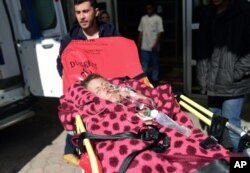
    Turkish medics carry a wounded Syrian child to a hospital in Kilis, Turkey, Feb. 16, 2016.
    Turkish medics carry a wounded Syrian child to a hospital in Kilis, Turkey, Feb. 16, 2016.

    New tide of refugees

    According to Turkey’s Hurriyet newspaper, Turkish security officials have warned that PYD militias and Assad regime forces are trying to create a new tide of refugees wave by moving toward Azaz, from which 10 refugee camps stretch along an eight-kilometer route to Kilis in Turkey.

    YPG commanders deny they are part of the Assad regime's offensive, or coordinating their activities with Russia's warplanes. They contend they have sheltered Arab Sunni families who fled heavy fighting in the Kurdish enclave of Afrin.

    Syrian rebel commanders, however, insist there has been clear military coordination, and say they will never forgive what they consider treachery by the Kurds.

    Regardless of the ultimate outcome of Syria's five-year-long civil war, which has already left upwards of 250,000 dead and 11 million people displaced, the Syrian rebels say they will exact revenge on the Kurds for joining a battlefield alliance with the Assad regime.
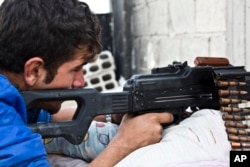
    FILE - Young Kurdish People's Protection Units (YPG) fighter who recently volunteered holds a position with his weapon in Kobani, Syria.
    FILE - Young Kurdish People's Protection Units (YPG) fighter who recently volunteered holds a position with his weapon in Kobani, Syria.

    Kurd betrayal

    General Salem Idris, former chief of staff of the Western-backed Free Syrian Army, contends such revenge is inevitable. He says the FSA and the political opposition cautioned U.S. officials that while the YPG may have been a useful ally for the West in the struggle to defeat Islamic State jihadists, in the longer term it was always ready to work with the Assad regime.  

    "There is very strong coordination between the YPG and the regime," Idris says. "It is not hidden today.”

    The moment the regime's offensive began, after repeated Russian airstrikes against rebel targets, Idris said the YPG decided Assad was likely to win and grasped the opportunity to side openly with the regime on the battlefield.

    “This will have bad results for the Kurds in the future," the Free Syrian Army general said. "People will remember what they did when we were fighting the regime and Hezbollah, and the Russians and all the mercenaries from Iran and Iraq as well as the Islamic State. They came from behind and attacked us.”

    “The U.S. could put more pressure on the Kurds to stop” their intervention on the side of the regime, Idris said.

    Other rebel commanders also voice deep bitterness toward the Kurds' political party, the PYD, which they blame for repeated failure of the rebels' efforts to arrange a truce with the Kurdish militiamen.

    “They tricked us,” says Mohammed Adeeb of the rebel alliance known as the Shamiya Front.  

    Nader Othman, the deputy prime minister of the opposition Syrian Interim Government, also says the PYD will come to regret its actions against Sunni Arabs, and he predicts that Kurdish leaders “will discover [Syrian President Bashar] Assad is not to be trusted.”

    “He will turn on them when the opportunity presents itself,” Othman said. “But the problem for us is now, and the problem is that the U.S. sees the YPG as a partner when it comes to the Islamic State.”

    Impact on US policy

    The Kurdish fighters' battlefield moves have been devastating for U.S. policy in Syria, and they are unraveling the alliance the Obama administration has been trying to build to confront and destroy the Islamic State group, according to Daveed Gartenstein-Ross, an analyst with the Foundation for the Defense of Democracies, a Washington think tank.

    “It's a complete wreck,” says Gartenstein-Ross. “There are literally U.S.-backed groups fighting other U.S.-backed groups right now. Specifically, the U.S.-backed opposition in northern Aleppo is fighting the U.S.-backed YPG. I have never seen a situation where one CIA-backed group is fighting another with this kind of intensity. It illustrates why so many people have trouble trusting the United States. It's hard for people to believe our government is this incompetent, so they search for some hidden conspiracy,” he says.

    You May Like

    Clinton, Trump and the 'Woman’s Card'

    Ask supporters of Democratic front-runner in US presidential campaign, and they’ll tell you Republican presidential candidate is playing a dangerous hand

    Russian Censorship Group Seeks Chinese Help to Better Control Internet

    At recent Safe Internet League forum in Moscow, speakers from both nations underscored desire for authorities to further limit and control information online

    Video Makeshift Pakistani School Helps Slum Kids

    Free classes in Islamabad park serve a few of the country’s nearly 25 million out-of-school youths; NGO cites ‘education crisis’

    This forum has been closed.
    Comment Sorting
    Comments page of 2
        Next 
    by: JarekSteliga from: Poland
    February 18, 2016 4:05 PM
    " It illustrates why so many people have trouble trusting the United States. It's hard for people to believe our government is this incompetent, so they search for some hidden conspiracy". How true. I certainly am one of these people and my personal conspiracy theory is that American Military Industrial Complex rules the roost and is behind all this mayhem. That seems to me the only logical explanation of events, barring mental retardation of US politicians and the nation which voted them to power.

    by: mel perry from: san francisco
    February 16, 2016 10:19 PM
    what you sow, so shall you reap

    by: Phllip A Nagle from: United States
    February 16, 2016 5:54 PM
    Turkery, along with Saudi Arabia and the US were the main perpetrators in starting the Syrian civil war. Turkey has been the main ally of ISIS, buying their oil in exchange for military supplies. This Syrian civil has been a disaster for Sunni Islamists whose goal has always been to turn Syria into a Sunni Islamic dictatorship. The winners of this bloody civil war may well be the Kurds who will emerge with a de facto nation in Iraq and Syria and an ally in the large Kurdish minority of Turkey ready to rise up.

    by: williweb from: Phoenix Arizona USA
    February 16, 2016 4:13 PM
    The US should "git" out of this Syria quagmire while the "gittin" is good. The Kurds, Russians, Iranians, Turks, Saudi's can blame each other for bombing hospitals, schools, civilians and let allah sort out the bodies. The US led anti-IS coalition has more work to do. We must see this to a conclusion, which means IS gone.

    by: Kafantaris
    February 16, 2016 2:40 PM
    The battle for Aleppo is Syria's Gettysburg -- and all sides know it. So why have we resigned to its outcome? Aleppo is still a fluid battlefield.

    by: Kawa
    February 16, 2016 1:11 PM
    What should kurds do? they were excluded in Genve talks and they were never welcomed as kurds and were not taken seriously in the beginning by oppositions because of Turkey. And don't forget that it was the kurds who raised against Assad first. BTW, U.S knows who is friends and who is enemy. they are not stupid and they know kurds are not manipulative

    by: Christopher Jensen from: United States
    February 16, 2016 1:07 PM
    This proves that the US should have been a stronger supporter of the Kurds and YPG when they had the chance. We could have helped form the doctrine that would allow them to win and keep their borders and have allowed them to at least have the appearance on the world stage as the "good guys". Note that the Kurds are taking in Syrian Refugees, and should continue that policy and make a large statements about it.

    by: martin archer
    February 16, 2016 12:51 PM
    Go Kurds go. Ignore the vacillating and naive US and take back Kurdistan from the Arabs Saddam and Assad forced on you. It's not your fault the US proved to be so weak and leaderless.

    Somewhere somehow the US lost its moral compass and began to support the likes of Endogan and the Ayatollah who want the older middle east borders maintained instead of supporting Israel and the Kurds who want to be on their own land and free of Islamic overlords.
    In Response

    by: Anonymous
    February 17, 2016 3:26 AM
    Most part of Kurdistan is in so-called fake Turkey.

    by: Anonymous
    February 16, 2016 12:45 PM
    A guide on who is who in Syria:
    The Syrian Observatory for Human Rights: A Single Sunni refugee in London, biased against the Syrian Government. FSA, Nusra Front, Turkmen Brigades: b.s names, used by the western media to avoid using AQ, since all these groups are AQ. AQ in Syria is also called "moderate rebels", "opposition". The AQ (opposition) in the negotiations table, is misleadingly called High Negotiations Committee (HNC), where in fact it is a collection of AQ groups supported by Saudi Arabia and Turkey.

    The Kurds are not invited to negotiations, because Turkey opposed the Kurds presence in the negotiations. The Syrian Government, Russia, Iran, Hezbollah and The Kurds: Fighting ISIS and AQ, not just ISIS, but ISIS and AQ (above-mentioned groups). Saudi Arabia and Turkey: support ISIS and AQ (the above-mentioned AQ groups and several more).

    The west, NATO and especially Britain and part of the US including presidential candidate Clinton: support Saudi Arabia and Turkey. AQ in Syria are mostly foreign Chechens, Uzbeks, Tajiks, Tunisians, Saudis and Turks, imported by Turkey via Turkey into Syria.

    by: Marcus Aurelius II from: NJ USA
    February 16, 2016 11:31 AM
    The Kurds are only interested in defending themselves, not the rest of Syria or Iraq. That is as it should be. With the help of US air power they've proven to be the most effective fighting force on the ground against IS in the region. Syria and Russia are not fighting IS, they're mostly fighting the rebels to give the world an unpalatable choice between a Syria ruled by Assad and one ruled by IS. Will Iraq's cut and run military ever get its act together or will it continue to turn American weapons over to IS?

    Will the US be foolish enough to put troops on the ground in the middle of this mess? Hillary Clinton says if she's elected we'll get four more years of Obama. So if he sends ground troops does that mean she will too? If Turkey wants to provoke a war with Russia, why would the US risk its own security for it? NATO is a defensive treaty, not a suicide pact.

    Erdogan is a Sunni sectarian extremist who has betrayed Ataturk's vision of a modern secular Turkish nation. He should get no support in that regard from the US.

    He's as much a danger to Turkey as Assad is to Syria.
    Comments page of 2
        Next 

    Featured Videos

    Your JavaScript is turned off or you have an old version of Adobe's Flash Player. Get the latest Flash player.
    Turkish Kurd Islamist Rally Stokes Tensionsi
    X
    April 29, 2016 12:28 AM
    In a sign of the rising power of Islamists in Turkey, more than 100,000 people recently gathered in Diyarbakir, the main city in Turkey’s predominantly Kurdish southeast, to mark the birthday of the Prophet Muhammad. The gathering highlighted tensions with the pro-secular Kurdish nationalist movement. Dorian Jones reports from Diyarbakir.
    Video

    Video Turkish Kurd Islamist Rally Stokes Tensions

    In a sign of the rising power of Islamists in Turkey, more than 100,000 people recently gathered in Diyarbakir, the main city in Turkey’s predominantly Kurdish southeast, to mark the birthday of the Prophet Muhammad. The gathering highlighted tensions with the pro-secular Kurdish nationalist movement. Dorian Jones reports from Diyarbakir.
    Video

    Video Pakistani School Helps Slum Kids

    Master Mohammad Ayub runs a makeshift school in a public park in Islamabad. Thousands of poor children have benefited from his services over the years, but, as VOA's Ayesha Tanzeem reports, roughly 25 million school-age youths don't get an education in Pakistan.
    Video

    Video Florida’s Weeki Wachee ‘Mermaids’ Make a Splash

    Since 1947, ‘mermaids’ have fascinated tourists at central Florida’s Weeki Wachee Springs State Park with their fluid movements and synchronized ballet. Performing underwater has its challenges, including cold temperatures and a steady current, as VOA’s Lin Yang and Joseph Mok report.
    Video

    Video Somali, African Union Forces Face Resurgent Al-Shabab

    The Islamic State terror group claimed its first attack in Somalia earlier this week, though the claim has not been verified by forces on the ground. Meanwhile, al-Shabab militants have stepped up their attacks as Somalia prepares for elections later this year. Henry Ridgwell reports there are growing frustrations among Somalia’s Western backers over the country’s slow progress in forming its own armed forces to establish security after 25 years of chaos.
    Video

    Video Bangladesh Targeted Killings Spark Wave of Fear

    People in Bangladesh’s capital are expressing deep concern over the brutal attacks that have killed secular blogger, and most recently a gay rights activist and an employee of the U.S. embassy. Xulhaz Mannan, an embassy protocol officer and the editor of the country’s only gay and transgender magazine Roopban; and his friend Mehboob Rabbi Tanoy, a gay rights activist, were hacked to death by five attackers in Mannan’s Dhaka home earlier this month.
    Video

    Video Documentary Tells Tale of Chernobyl Returnees

    Ukraine this week is marking the 30th anniversary of the world's worst nuclear accident, at the Chernobyl nuclear power plant. Soviet officials at first said little about the accident, but later evacuated a 2,600-square-kilometer "exclusion zone." Some people, though, came back. American directors Holly Morris and Anne Bogart created a documentary about this faithful and brave community. VOA's Tetiana Kharchenko reports from New York on "The Babushkas of Chernobyl." Carol Pearson narrates.
    Video

    Video Nigerians Feel Bite of Buhari Economic Policy

    Despite the global drop in the price of oil, Nigerian President Muhammadu Buhari has refused to allow the country's currency to devalue, leading to a shortage of foreign exchange. Chris Stein reports from Lagos businessmen and consumers are feeling the impact as the country deals with a severe fuel shortage.
    Video

    Video  Return to the Wild

    There’s a growing trend in the United States to let old or underused golf courses revert back to nature. But as Erika Celeste reports from one parcel in Grafton, Ohio, converting 39 hectares of land back to green space is a lot more complicated than just not mowing the fairway.
    Video

    Video West Urges Unity in Libya as Migrant Numbers Soar

    The Italian government says a NATO-led mission aimed at stemming the flow of migrants from Libya to Europe could be up and running by July. There are concerns that the number of migrants could soar as the route through Greece and the Balkans remains blocked. Western powers say the political chaos in Libya is being exploited by people smugglers — and they are pressuring rival groups to come together under the new unity government. VOA's Henry Ridgwell reports.
    Video

    Video Russia’s TV Rain Swims Against Tide in Sea of Kremlin Propaganda

    Russia’s media freedoms have been gradually eroded under President Vladimir Putin as his government has increased state ownership, influence, and restrictions on critical reporting. Television, where most Russians get their news, has been the main target and is now almost completely state controlled. But in the Russian capital, TV Rain stands out as an island in a sea of Kremlin propaganda.

    Special Report

    Adrift The Invisible African Diaspora