


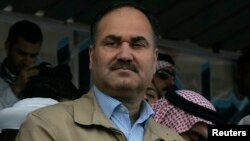
Iraq's Sunni finance minister announced his resignation Friday at a large protest demonstration in the mostly Sunni town of Samara. Twin bombings also hit a cattle market in a mostly Shi'ite town south of Baghdad, killing at least five.
The crowd of several thousand protesters cheered the announcement by Sunni Finance Minister Rafaie al-Esawi that he was resigning from the embattled government of Prime Minister Nouri al-Maliki.
He says that he's not keen to serve an Iraqi government that does not respect the people of Iraq, their future, their unity, or their tribes. He says that he is with the people and will not be part of a government that has the blood of the Iraqi people on its hands.
But Iraqi state TV reported during its afternoon newscast that Prime Minister Maliki "would not accept, Rafaie al-Esawi, resignation until the investigation into his financial and administrative 'crimes' had been investigated."
The conflict between the Shi'ite prime minister and his Sunni finance minister is just the latest sectarian conflict within Maliki's government.
Vice President Tariq Hashemi fled Iraq in Dec. 2011 and was tried in absentia for alleged 'terrorist' activities. Hashemi denied the allegations, calling them "politically motivated."
Former Prime Minister Ayad Allawi, who heads the Iraqiya Party, which won the largest number of seats in Iraq's 2010 parliamentary elections, recently accused Mr. Maliki and his supporters of trying to assassinate him. Iraq is due to hold local council elections in April.
A crowd of women shouted and screamed after two explosions hit a cattle market in the mostly Shi'ite town of Diwaniyah, south of Baghdad. Dozens of people were killed or wounded according to the town's health director.
A teenage boy who was wounded by the blasts recalled what happened. He says that he felt an explosion from one of the vehicles at the market and a short while later he heard a second explosion and saw (another vehicle) blow up.
Middle East analyst James Denselow of King's College London says Iraq has yet to stabilize either politically or security-wise in the almost ten years since the overthrow of former leader Saddam Hussein:
"What we see today in Iraq is a zombie state that is unable to move forward on any of the real issues that face the country and instead it's grid-locked in a sectarian to-and-fro of personal attacks and physical attacks and....a continued low level violence on the street," Denselow said.
Denselow says the recent widespread protests in the large Sunni towns and cities reflects a "more assertive Sunni constituency." Observers, he adds, worry that the "low level sectarian conflict and political sniping, could turn into (a new) civil war."
The crowd of several thousand protesters cheered the announcement by Sunni Finance Minister Rafaie al-Esawi that he was resigning from the embattled government of Prime Minister Nouri al-Maliki.
He says that he's not keen to serve an Iraqi government that does not respect the people of Iraq, their future, their unity, or their tribes. He says that he is with the people and will not be part of a government that has the blood of the Iraqi people on its hands.
But Iraqi state TV reported during its afternoon newscast that Prime Minister Maliki "would not accept, Rafaie al-Esawi, resignation until the investigation into his financial and administrative 'crimes' had been investigated."
The conflict between the Shi'ite prime minister and his Sunni finance minister is just the latest sectarian conflict within Maliki's government.
Vice President Tariq Hashemi fled Iraq in Dec. 2011 and was tried in absentia for alleged 'terrorist' activities. Hashemi denied the allegations, calling them "politically motivated."
Former Prime Minister Ayad Allawi, who heads the Iraqiya Party, which won the largest number of seats in Iraq's 2010 parliamentary elections, recently accused Mr. Maliki and his supporters of trying to assassinate him. Iraq is due to hold local council elections in April.
A crowd of women shouted and screamed after two explosions hit a cattle market in the mostly Shi'ite town of Diwaniyah, south of Baghdad. Dozens of people were killed or wounded according to the town's health director.
A teenage boy who was wounded by the blasts recalled what happened. He says that he felt an explosion from one of the vehicles at the market and a short while later he heard a second explosion and saw (another vehicle) blow up.
Middle East analyst James Denselow of King's College London says Iraq has yet to stabilize either politically or security-wise in the almost ten years since the overthrow of former leader Saddam Hussein:
"What we see today in Iraq is a zombie state that is unable to move forward on any of the real issues that face the country and instead it's grid-locked in a sectarian to-and-fro of personal attacks and physical attacks and....a continued low level violence on the street," Denselow said.
Denselow says the recent widespread protests in the large Sunni towns and cities reflects a "more assertive Sunni constituency." Observers, he adds, worry that the "low level sectarian conflict and political sniping, could turn into (a new) civil war."