


Tibetan sources tell VOA that two men have died after setting themselves on fire to protest Chinese rule in Tibetan regions of China.
The two men, a monk and a former monk, carried out the self-immolation protest on Monday on a street in Ngaba Tibetan and Qiang Autonomous Prefecture of central China's Sichuan province.
An India-based spokesman for the Kirti monastery of Tibetan Buddhism said Chinese authorities informed family members that the two men were taken to a hospital in Barkham county and died of their injuries. A resident of the Chinese region who spoke to VOA confirmed that account.
The self-immolations happened near the Ngaba county branch of the Kirti monastery, which follows the Gelug school of Buddhism of the Dalai Lama, Tibet's exiled spiritual leader.
The sources said one of the men, Lungtok, was a monk at the monastery, while the other, Tashi, was a former monk and classmate of Lungtok. They said the two men, who were in their early 20s, set themselves on fire as they chanted anti-government slogans on a major road known to locals as "Martyrs Street" in honor of other ethnic Tibetans who have died in self-immolations.
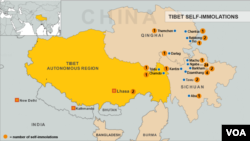
About 50 Tibetans have set themselves on fire since 2009 in protest at what they see as Chinese repression of their religion and culture - a charge Beijing denies. Most of the self-immolations have happened in Ngaba prefecture. Three Tibetans in that region died in self-immolations last week - a monk, another man, and a woman.
The Chinese government has described the self-immolations as barbaric terrorist acts and has accused overseas groups and the Dalai Lama of inciting separatism.
The two men, a monk and a former monk, carried out the self-immolation protest on Monday on a street in Ngaba Tibetan and Qiang Autonomous Prefecture of central China's Sichuan province.
An India-based spokesman for the Kirti monastery of Tibetan Buddhism said Chinese authorities informed family members that the two men were taken to a hospital in Barkham county and died of their injuries. A resident of the Chinese region who spoke to VOA confirmed that account.
The self-immolations happened near the Ngaba county branch of the Kirti monastery, which follows the Gelug school of Buddhism of the Dalai Lama, Tibet's exiled spiritual leader.
Kirti Monastery of Tibetan Buddhism
The Kirti Monastery of Tibetan Buddhism:- Follows the Gelug school of Buddhism of the Dalai Lama
- Main branch is in Ngaba county in Sichuan province's Ngaba Tibetan and Qiang Autonomous Prefecture
- Ngaba county's branch has about 3,000 monks
- There are 40 other branches in Sichuan, Gansu and Qinghai provinces
- Kirti Monastery also has a branch Dharamsala, India, the seat of the Tibetan government-in-exile
The sources said one of the men, Lungtok, was a monk at the monastery, while the other, Tashi, was a former monk and classmate of Lungtok. They said the two men, who were in their early 20s, set themselves on fire as they chanted anti-government slogans on a major road known to locals as "Martyrs Street" in honor of other ethnic Tibetans who have died in self-immolations.
About 50 Tibetans have set themselves on fire since 2009 in protest at what they see as Chinese repression of their religion and culture - a charge Beijing denies. Most of the self-immolations have happened in Ngaba prefecture. Three Tibetans in that region died in self-immolations last week - a monk, another man, and a woman.
The Chinese government has described the self-immolations as barbaric terrorist acts and has accused overseas groups and the Dalai Lama of inciting separatism.