


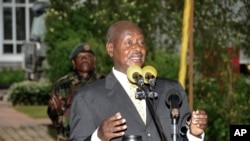
Uganda’s deputy justice and constitutional minister has sharply rejected opposition criticisms that the government is intolerant of dissenting views.
Uganda’s constitution protects the freedom of expression and association as well as the freedom to demonstrate peacefully.
“However, when you are doing that, do it in such a way that you do not also infringe on the rights of others,” said Frederic Ruhindi. “I think that is a fair qualification within the constitution.
“The government has been tolerant,” he added. “Every type of media is in Uganda. Tell me which paper has Uganda banned? They write whatever they want to write and if anybody is aggrieved by what anyone is writing, he or she goes to court, either for libel or for defamation. That’s legitimate.”
The political opposition and civil society groups have often accused the government of infringing on their constitutional rights. They contend that state security agencies frequently arrest, intimidate and crackdown on opposition protests. The government rejects their criticisms as without merit.
Ruhindi also dismissed a human rights report that President Yoweri Museveni’s administration has refused to investigate the deaths of at least 40 people during two days of rioting three years ago.
In its report, U.S.-based Human Rights Watch (HRW) said the government has yet to investigate the deaths during the “Kayunga riots” despite numerous promises to do so. Human Rights Watch said a parliamentary committee examining the incident has stalled, failing to call any witnesses. No police or military members, the rights group said, have been held accountable for the violence.
“The long government inaction on the killings of people in September 2009 is an insult to victims. Resorting to lethal force without clear justification in the face of protests is unacceptable, yet it is becoming the norm in Uganda,” said Maria Burnett, senior Africa researcher at Human Rights Watch.
On September 10 and 11, 2009, Ugandan security officials tried to prevent the cultural leader of the Buganda ethnic group from traveling to Kayunga, a town near the capital, Kampala. His enraged supporters took to the streets in protest. They threw stones and set garbage on fire.
Human Rights Watch said the military and police responded by shooting into the crowd, leaving at least 40 protesters dead.
Ruhindi said the government is working on measures to investigate the incident and prosecute those responsible.
“I wish those [accusers] could be frank enough to say that government should actually investigate all wrongdoers,” said Ruhindi.
“Where in the world would you find an ordinary person hitting a policeman or policewoman? Where, other than Uganda and that person goes scot free? he asked.
Uganda’s constitution protects the freedom of expression and association as well as the freedom to demonstrate peacefully.
“However, when you are doing that, do it in such a way that you do not also infringe on the rights of others,” said Frederic Ruhindi. “I think that is a fair qualification within the constitution.
“The government has been tolerant,” he added. “Every type of media is in Uganda. Tell me which paper has Uganda banned? They write whatever they want to write and if anybody is aggrieved by what anyone is writing, he or she goes to court, either for libel or for defamation. That’s legitimate.”
The political opposition and civil society groups have often accused the government of infringing on their constitutional rights. They contend that state security agencies frequently arrest, intimidate and crackdown on opposition protests. The government rejects their criticisms as without merit.
Ruhindi also dismissed a human rights report that President Yoweri Museveni’s administration has refused to investigate the deaths of at least 40 people during two days of rioting three years ago.
In its report, U.S.-based Human Rights Watch (HRW) said the government has yet to investigate the deaths during the “Kayunga riots” despite numerous promises to do so. Human Rights Watch said a parliamentary committee examining the incident has stalled, failing to call any witnesses. No police or military members, the rights group said, have been held accountable for the violence.
“The long government inaction on the killings of people in September 2009 is an insult to victims. Resorting to lethal force without clear justification in the face of protests is unacceptable, yet it is becoming the norm in Uganda,” said Maria Burnett, senior Africa researcher at Human Rights Watch.
On September 10 and 11, 2009, Ugandan security officials tried to prevent the cultural leader of the Buganda ethnic group from traveling to Kayunga, a town near the capital, Kampala. His enraged supporters took to the streets in protest. They threw stones and set garbage on fire.
Human Rights Watch said the military and police responded by shooting into the crowd, leaving at least 40 protesters dead.
Ruhindi said the government is working on measures to investigate the incident and prosecute those responsible.
“I wish those [accusers] could be frank enough to say that government should actually investigate all wrongdoers,” said Ruhindi.
“Where in the world would you find an ordinary person hitting a policeman or policewoman? Where, other than Uganda and that person goes scot free? he asked.
