



KAMPALA — Uganda is battling yet another outbreak of the Ebola virus, with 14 deaths reported so far and a number of people in quarantine.
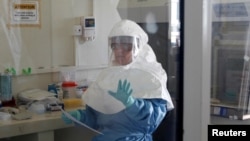
Ugandan newspapers are filled once again with images of hazmat suits and hospital beds, as the country is rocked by a new outbreak of the deadly Ebola virus.
Addressing journalists on Monday, Minister of Health Christine Ondoa said there was no cause for alarm. She said the ministry, working with the U.S. Centers for Disease Control and Prevention and the World Health Organization, had managed to contain the virus. But in an address to the nation the same day, Ugandan President Yoweri Museveni urged people to avoid all physical contact, including shaking hands.
Although most of the cases come from western Uganda, some have also been reported in the capital, Kampala. The city’s main hospital has set up an isolation ward for those suspected of being infected, while a number of people in western Uganda have been placed in quarantine.
This is not the first time Ebola has gripped the country. Thirty-seven people died in the last outbreak in 2007, and an epidemic in 2000 killed nearly 200. Symptoms of the hemorrhagic fever include diarrhea and vomiting.
Denis Lwamafa of the Ministry of Health says Uganda has improved its ability to detect and diagnose Ebola.
“Uganda now is probably at the forefront, in terms of handling viral hemorrhagic fevers, on the continent of Africa," says Lwamafa. "So this is now an indigenous local capacity of which we must take note. We’ve been able to elevate the level of proficiency in diagnosing even these highly infectious organisms here in Uganda, and I would like to report that the diagnosis of the Ebola virus was done here.”
He adds that although the disease does occur in neighboring countries as well, it is not always detected.
“In other countries, especially in some of the neighboring countries, many times Ebola goes unrecognized, and other times is goes unreported, because it has the capacity to burn itself out," says Lwamafa. "In some of the neighboring states, Ebola comes and wipes out even whole villages, and after a certain time, because there is nobody else to infect, it dies out.”
According to Joaquim Saweka of the World Health Organization, the first cases of Ebola earlier this month were originally mistaken for cholera. The outbreak began in the western district of Kibale, close to a forest which, Saweka says, could well be the source of the disease.
“One of the intermediaries for transmission of Ebola can be monkeys and bats," says Saweka. "And the sites where most of the cases occurred are close to Kibale forest where there are a lot of monkeys. So one of the risk factors was there, but we could not yet establish if there is a relation, and which, exactly, could be the agent.”
Lwamafa says the Ministry of Health is studying both wild and domestic animals in the areas most vulnerable to Ebola, with the aim of identifying the source of the virus.
Meanwhile, a high Ebola alert has been declared in Uganda's neighbor, Kenya.
Ugandan newspapers are filled once again with images of hazmat suits and hospital beds, as the country is rocked by a new outbreak of the deadly Ebola virus.
Addressing journalists on Monday, Minister of Health Christine Ondoa said there was no cause for alarm. She said the ministry, working with the U.S. Centers for Disease Control and Prevention and the World Health Organization, had managed to contain the virus. But in an address to the nation the same day, Ugandan President Yoweri Museveni urged people to avoid all physical contact, including shaking hands.
Although most of the cases come from western Uganda, some have also been reported in the capital, Kampala. The city’s main hospital has set up an isolation ward for those suspected of being infected, while a number of people in western Uganda have been placed in quarantine.
This is not the first time Ebola has gripped the country. Thirty-seven people died in the last outbreak in 2007, and an epidemic in 2000 killed nearly 200. Symptoms of the hemorrhagic fever include diarrhea and vomiting.
Denis Lwamafa of the Ministry of Health says Uganda has improved its ability to detect and diagnose Ebola.
“Uganda now is probably at the forefront, in terms of handling viral hemorrhagic fevers, on the continent of Africa," says Lwamafa. "So this is now an indigenous local capacity of which we must take note. We’ve been able to elevate the level of proficiency in diagnosing even these highly infectious organisms here in Uganda, and I would like to report that the diagnosis of the Ebola virus was done here.”
He adds that although the disease does occur in neighboring countries as well, it is not always detected.
“In other countries, especially in some of the neighboring countries, many times Ebola goes unrecognized, and other times is goes unreported, because it has the capacity to burn itself out," says Lwamafa. "In some of the neighboring states, Ebola comes and wipes out even whole villages, and after a certain time, because there is nobody else to infect, it dies out.”
According to Joaquim Saweka of the World Health Organization, the first cases of Ebola earlier this month were originally mistaken for cholera. The outbreak began in the western district of Kibale, close to a forest which, Saweka says, could well be the source of the disease.
“One of the intermediaries for transmission of Ebola can be monkeys and bats," says Saweka. "And the sites where most of the cases occurred are close to Kibale forest where there are a lot of monkeys. So one of the risk factors was there, but we could not yet establish if there is a relation, and which, exactly, could be the agent.”
Lwamafa says the Ministry of Health is studying both wild and domestic animals in the areas most vulnerable to Ebola, with the aim of identifying the source of the virus.
Meanwhile, a high Ebola alert has been declared in Uganda's neighbor, Kenya.