



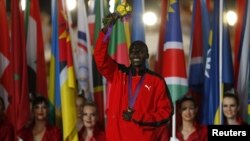
KAMPALA, Uganda — Ugandans are celebrating their first Olympic gold medalist since 1972, when John Akii Bua won under Idi Amin's dictatorship. Things have become more difficult for Ugandan athletes, however, since Amin’s time.
As Ugandan marathon runner Stephen Kiprotich took his place on the gold medal podium on the final day of the London Olympics, the whole world watched as the Ugandan national anthem rang out in the Olympic stadium.
It was an emotional moment for many Ugandans, one for which they had been waiting for 40 years.
At least one person in Kampala had tears in his eyes when he heard Kiprotich had won.
“After 40 years, this was amazing. And hearing our national anthem being sung in the stadium, it was so great and so amazing. You can’t imagine - 40 years back! We are so happy," said the man. "You find like, the United States took about 90 medals, but they are not happy like us who took one, because it was unexpected.”
Forty-year wait for gold
Until last Sunday, Uganda’s only gold medalist was Akii Bua, the 400-meter hurdler who won in Munich in '72. At that time Uganda was a new and little-known country, and Akii Bua’s victory took the world by surprise.
Now he is remembered as a national hero. But several years after Munich, afraid for his life, Akii Bua was forced to flee the increasingly brutal and paranoid regime of Idi Amin. He spent some time in a Kenyan refugee camp before moving to Germany.
The notorious dictator’s obsession with all things physical is one of the reasons Akii Bua won gold in the first place. Amin took a personal interest in sports, and would often visit the athletes himself. As Beatrice Ayikoru of the Uganda Athletics Federation explains, this meant more resources for sports.
“Idi Amin was a sportsman. I think he was a boxer. And I think he has also seen how sports was used to unite the people, to market the country, and all those values. At that time things were different. There was money for sportsmen,” said Ayikoru.
Past emphasis on athletics, training
When Akii Bua won his medal in the 1970s, it was the golden age of Ugandan athletics. The country was full of sports clubs. The police, the army and the private sector all trained their own athletes, hired professional coaches and provided facilities. Akii Bua himself was a police officer, and his British coach was employed by the government.
While few mourn the passing of such a bloodthirsty regime, Ayikoru said Ugandan athletics have suffered since Amin was overthrown in 1979.
“All banks removed sports clubs. The government institutions like police, prisons and army reduced spending on sports. The private sector that was there completely dropped sports. So that was the beginning of the challenge for many sportsmen and women, because without a financier you cannot perform,” said Ayikoru.
The lack of resources has taken its toll. Today, Uganda’s athletics coaches are all volunteers. And many of the sports facilities built in Amin’s time are deteriorating. The country’s only decent track is in the national stadium in Kampala, and it often is used for other things.
Competing interests take precedence
Ugandan sprinter Ali Ngaimoko said that just last June, the Uganda Athletics Federation was told they could not use the stadium for their national championships because of a gospel concert.
“Our national championships, can you imagine? So there was some event [and] we were kicked out. We had to go and use grass. And most of our athletes, like the sprinters, that was the last chance for them to hit the time to be in the Olympics,” said Ngaimoko.
Uganda has long stood in the shadow of neighboring Kenya, whose athletic superstars and world-class facilities attract media attention and sportsmen from around the world. Western Kenya’s high-altitude training centers are where elite Ugandan athletes like Kiprotich go to train.
Ayikoru said facilities like these not only improve athletes, but also can create them.
‘The youth, they are inspired. They see these people running every day. It makes it very easy for them to be identified. So they join them, and many of them come up,” said Ayikoru.
Changing mindset taking hold
But Ayikoru said there are plans underway to build a similar center in eastern Uganda. She hopes this will inspire young Ugandans to take up athletics, and allow them to do their training at home.
For his part, Ngaimoko hopes this year’s gold medal will open people’s eyes to the talent in Uganda, and make it easier for athletes like himself to compete.
“I’m pretty sure things are going to change. Because you know, we had been waiting for that for so long. This time around, at least our flag is up. We are very happy. Ugandans are very happy,” he said.
When Kiprotich crossed the finish line on Sunday, the Ugandan flag streaming over his head, he may have overcome even greater odds than Akii Bua himself.
As Ugandan marathon runner Stephen Kiprotich took his place on the gold medal podium on the final day of the London Olympics, the whole world watched as the Ugandan national anthem rang out in the Olympic stadium.
It was an emotional moment for many Ugandans, one for which they had been waiting for 40 years.
At least one person in Kampala had tears in his eyes when he heard Kiprotich had won.
“After 40 years, this was amazing. And hearing our national anthem being sung in the stadium, it was so great and so amazing. You can’t imagine - 40 years back! We are so happy," said the man. "You find like, the United States took about 90 medals, but they are not happy like us who took one, because it was unexpected.”
Forty-year wait for gold
Until last Sunday, Uganda’s only gold medalist was Akii Bua, the 400-meter hurdler who won in Munich in '72. At that time Uganda was a new and little-known country, and Akii Bua’s victory took the world by surprise.
Now he is remembered as a national hero. But several years after Munich, afraid for his life, Akii Bua was forced to flee the increasingly brutal and paranoid regime of Idi Amin. He spent some time in a Kenyan refugee camp before moving to Germany.
The notorious dictator’s obsession with all things physical is one of the reasons Akii Bua won gold in the first place. Amin took a personal interest in sports, and would often visit the athletes himself. As Beatrice Ayikoru of the Uganda Athletics Federation explains, this meant more resources for sports.
“Idi Amin was a sportsman. I think he was a boxer. And I think he has also seen how sports was used to unite the people, to market the country, and all those values. At that time things were different. There was money for sportsmen,” said Ayikoru.
Past emphasis on athletics, training
When Akii Bua won his medal in the 1970s, it was the golden age of Ugandan athletics. The country was full of sports clubs. The police, the army and the private sector all trained their own athletes, hired professional coaches and provided facilities. Akii Bua himself was a police officer, and his British coach was employed by the government.
While few mourn the passing of such a bloodthirsty regime, Ayikoru said Ugandan athletics have suffered since Amin was overthrown in 1979.
“All banks removed sports clubs. The government institutions like police, prisons and army reduced spending on sports. The private sector that was there completely dropped sports. So that was the beginning of the challenge for many sportsmen and women, because without a financier you cannot perform,” said Ayikoru.
The lack of resources has taken its toll. Today, Uganda’s athletics coaches are all volunteers. And many of the sports facilities built in Amin’s time are deteriorating. The country’s only decent track is in the national stadium in Kampala, and it often is used for other things.
Competing interests take precedence
Ugandan sprinter Ali Ngaimoko said that just last June, the Uganda Athletics Federation was told they could not use the stadium for their national championships because of a gospel concert.
“Our national championships, can you imagine? So there was some event [and] we were kicked out. We had to go and use grass. And most of our athletes, like the sprinters, that was the last chance for them to hit the time to be in the Olympics,” said Ngaimoko.
Uganda has long stood in the shadow of neighboring Kenya, whose athletic superstars and world-class facilities attract media attention and sportsmen from around the world. Western Kenya’s high-altitude training centers are where elite Ugandan athletes like Kiprotich go to train.
Ayikoru said facilities like these not only improve athletes, but also can create them.
‘The youth, they are inspired. They see these people running every day. It makes it very easy for them to be identified. So they join them, and many of them come up,” said Ayikoru.
Changing mindset taking hold
But Ayikoru said there are plans underway to build a similar center in eastern Uganda. She hopes this will inspire young Ugandans to take up athletics, and allow them to do their training at home.
For his part, Ngaimoko hopes this year’s gold medal will open people’s eyes to the talent in Uganda, and make it easier for athletes like himself to compete.
“I’m pretty sure things are going to change. Because you know, we had been waiting for that for so long. This time around, at least our flag is up. We are very happy. Ugandans are very happy,” he said.
When Kiprotich crossed the finish line on Sunday, the Ugandan flag streaming over his head, he may have overcome even greater odds than Akii Bua himself.