



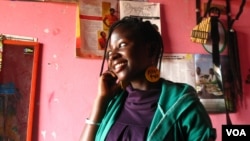
KAMPALA, Uganda – While the world's leading experts on HIV/AIDS are preparing for the upcoming AIDS 2012 Conference in Washington, D.C., one young Ugandan activist is focusing on problems much closer to home.
“I am Barbara Kemigisa, I am an activist and an upcoming artist, a single mother living with HIV,” Kemigisa tells the audience. She is fighting to rid her generation of the stigma attached to HIV, and to convince young HIV positives that their lives are not over yet.
On a sultry Kampala afternoon, the 26-year-old singer is rehearsing a new song in a make-shift sound studio in the Ugandan capital. This is not a love ballad or the next hot dance tune. Like everything Kemigisa does, her music is about self-confidence, hope and the possibilities of living with HIV.
Vibrant and charismatic, Kemigisa has become a spokeswoman for thousands of young people in Uganda, a country with an HIV infection rate of around seven percent. The founder an organization called Stigma Free Generation, she puts in regular appearances on TV and radio shows, tells her story in magazine articles, and speaks in churches and schools.
Uphill battle
Kemigisa’s message to young people is this: do not let your HIV status destroy your life, conquer the stigma within you, and do not be afraid to say you are HIV positive.
But, Kemigisa says, it is an uphill battle.
“Because of stigma, people do not believe in themselves. Because of stigma, people can not test for HIV. People still say, ‘I would rather not know my status than test HIV positive.’ Mothers cannot save their unborn babies because they cannot tell their husbands that, I am HIV positive, I need your support,’” she says.
Kemigisa’s own story is difficult. Sexually molested as a child, she spent part of her teenage years living on the streets of Kampala. She eventually joined a church and discovered that she had a gift for counseling youth.
Kemigisa learned she was HIV positive when she was pregnant with her daughter, now three years old. But, she says, learning her status only galvanized her to try to help young people like herself.
“I kept what my passion was, to speak to young people," she explains. "I just looked at the whole issue of HIV, what it is all about, and I was like, 'OK, I think I know what I have to do.”
What she did was to come out very publicly about her status, wearing “HIV positive” earrings and T-shirts she made herself, and talking to everyone she met about the disease.
Stigma
She found that what hurt people the most was not HIV itself, but the stigma attached to it.
“It takes 40 years plus for HIV to kill, and it takes two years and less for AIDS to kill. But it takes 10 minutes and less for stigma to kill," Kemigisa notes. "Someone just tells you something small to put you down, and that person commits suicide.”
It is often young people who are the most devastated, she says.
“They believe if they get HIV, their life is cut short," adds Kemigisa. "They just look at the things they may not be able to do because they are HIV-positive.”
Sometimes HIV-positive people are treated as though they were already dead, says Kemigisa, describing what happened to a friend of hers.
“When the whole family found out, her dad even bought a coffin for her. ‘That is your coffin, we are just waiting for the day you die.’ You can pass somewhere and some guy calls at you, and [his] friends are like, ‘That one is already dead,” Kemigisa laments.
Kemigisa’s father disowned her when he learned her HIV status, and she practically never sees her family. But she manages to stay upbeat, and is still full of ideas for new projects.
Future plans
At the moment, Kemigisa is working on a reality TV show featuring young people living with HIV. She is also organizing a Miss HIV beauty pageant, to challenge stereotypes and boost girls’ confidence.
And then, of course, there is her music.
“’I dream of a city where people line up for a test, with ARVs [anti-retroviral drugs] at every drug shop, at every clinic; mothers taking the lead to save their unborn babies, and husbands supportive, with every neighbor in the fight towards an HIV-free generation," she says. "That is one of the verses for a song. I want to be the first lady to come out positive and sing about it.”
Despite her activism, Kemigisa will not be attending this month’s AIDS 2012 Conference in Washington, D.C. The reasons for that are political, she explains. But that has not stopped her from thinking big, as she dreams someday of spreading her message of hope throughout Africa, and, eventually, the world.
“I am Barbara Kemigisa, I am an activist and an upcoming artist, a single mother living with HIV,” Kemigisa tells the audience. She is fighting to rid her generation of the stigma attached to HIV, and to convince young HIV positives that their lives are not over yet.
On a sultry Kampala afternoon, the 26-year-old singer is rehearsing a new song in a make-shift sound studio in the Ugandan capital. This is not a love ballad or the next hot dance tune. Like everything Kemigisa does, her music is about self-confidence, hope and the possibilities of living with HIV.
Vibrant and charismatic, Kemigisa has become a spokeswoman for thousands of young people in Uganda, a country with an HIV infection rate of around seven percent. The founder an organization called Stigma Free Generation, she puts in regular appearances on TV and radio shows, tells her story in magazine articles, and speaks in churches and schools.
Uphill battle
Kemigisa’s message to young people is this: do not let your HIV status destroy your life, conquer the stigma within you, and do not be afraid to say you are HIV positive.
But, Kemigisa says, it is an uphill battle.
“Because of stigma, people do not believe in themselves. Because of stigma, people can not test for HIV. People still say, ‘I would rather not know my status than test HIV positive.’ Mothers cannot save their unborn babies because they cannot tell their husbands that, I am HIV positive, I need your support,’” she says.
Kemigisa’s own story is difficult. Sexually molested as a child, she spent part of her teenage years living on the streets of Kampala. She eventually joined a church and discovered that she had a gift for counseling youth.
Kemigisa learned she was HIV positive when she was pregnant with her daughter, now three years old. But, she says, learning her status only galvanized her to try to help young people like herself.
“I kept what my passion was, to speak to young people," she explains. "I just looked at the whole issue of HIV, what it is all about, and I was like, 'OK, I think I know what I have to do.”
What she did was to come out very publicly about her status, wearing “HIV positive” earrings and T-shirts she made herself, and talking to everyone she met about the disease.
Stigma
She found that what hurt people the most was not HIV itself, but the stigma attached to it.
“It takes 40 years plus for HIV to kill, and it takes two years and less for AIDS to kill. But it takes 10 minutes and less for stigma to kill," Kemigisa notes. "Someone just tells you something small to put you down, and that person commits suicide.”
It is often young people who are the most devastated, she says.
“They believe if they get HIV, their life is cut short," adds Kemigisa. "They just look at the things they may not be able to do because they are HIV-positive.”
Sometimes HIV-positive people are treated as though they were already dead, says Kemigisa, describing what happened to a friend of hers.
“When the whole family found out, her dad even bought a coffin for her. ‘That is your coffin, we are just waiting for the day you die.’ You can pass somewhere and some guy calls at you, and [his] friends are like, ‘That one is already dead,” Kemigisa laments.
Kemigisa’s father disowned her when he learned her HIV status, and she practically never sees her family. But she manages to stay upbeat, and is still full of ideas for new projects.
Future plans
At the moment, Kemigisa is working on a reality TV show featuring young people living with HIV. She is also organizing a Miss HIV beauty pageant, to challenge stereotypes and boost girls’ confidence.
And then, of course, there is her music.
“’I dream of a city where people line up for a test, with ARVs [anti-retroviral drugs] at every drug shop, at every clinic; mothers taking the lead to save their unborn babies, and husbands supportive, with every neighbor in the fight towards an HIV-free generation," she says. "That is one of the verses for a song. I want to be the first lady to come out positive and sing about it.”
Despite her activism, Kemigisa will not be attending this month’s AIDS 2012 Conference in Washington, D.C. The reasons for that are political, she explains. But that has not stopped her from thinking big, as she dreams someday of spreading her message of hope throughout Africa, and, eventually, the world.