


The United States, in concert with key allies, sharply tightened economic sanctions on Iran Monday to press Tehran to end a suspected drive for nuclear weapons. Britain and Canada joined the U.S. sanctions move, while other European countries are also planning punitive steps.
The combined actions were a show of resolve in the face of a report earlier this month by the U.N. nuclear agency that voiced serious concerns that Iran, despite its denials, is seeking to acquire nuclear weapons.
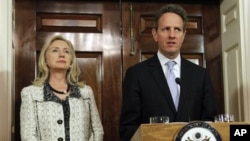
At a joint press event, Secretary of State Hillary Clinton and Treasury Secretary Timothy Geithner announced a major expansion of already wide-ranging nuclear-related U.S. sanctions on Tehran.
An executive order signed on Monday by President Barack Obama, tightens sanctions on Iran’s petrochemical industry and further restricts Tehran's ability to acquire equipment needed to maintain oil and gas production.
A U.S. blacklist of Iranian firms and individuals supporting the country’s uranium enrichment program is being expanded. And the Treasury Department is identifying Iran’s central bank as a “primary money laundering concern”, action that will broadly impede Iranian foreign trade.
Clinton said current sanctions already are having a “dramatic” effect on the Iranian economy and that even more pressure will be applied. “The impact will only grow unless Iran’s leaders decide to change course and meet their international obligations. And let me be clear. Today’s actions do not exhaust our opportunities to sanction Iran. We continue actively to consider a range of increasingly aggressive measures," she said.
Geithner stressed the importance of the money-laundering designation, authorized under the sweeping anti-terrorism Patriot Act passed by Congress after the 2001 terror attacks on the United States.
He said that although it stops short of barring all business with Iran’s central bank, the designation will affect foreign dealings with Iran across-the-board. “If you are a financial institution anywhere in the world and you engage in any transaction involving Iran’s central bank or any other Iranian bank operating inside or outside Iran, then you are at risk of supporting Iran’s illicit activities, its pursuit of nuclear weapons, its support for terrorism, and its efforts to deceive responsible financial institutions and to evade sanctions," he said.
Clinton said the United States remains committed to a “dual-track” strategy that includes diplomatic engagement with Iran, but that so far there is “little indication” that Iran is serious about negotiations on its nuclear program.
In a written statement, President Obama reiterated that his administration is “prepared to begin a new chapter” with Iran, but that Tehran “has chosen the path of international isolation.”
Hours before the U.S. announcement, Britain’s government ordered British financial institutions to end business dealings with all Iranian banks, including the central bank. Canada took similar action and announced an immediate export ban on all goods for Iran’s oil and gas industry.
The European Union is poised to announce major new sanctions on Iran as early as Tuesday.
US, Allies, Increase Sanctions on Iran