


LVIV, Ukraine — Ukrainian President Viktor Yanukovych has signed a law that restores many privileges to Russian, a language that was favored in the Soviet era.
Under the new law, an estimated half of Ukraine’s districts will allow government business to be conducted in Russian. About one quarter of Ukraine’s 46 million people are believed to speak Russian at home.
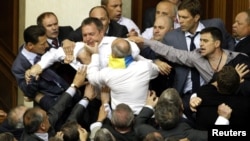
In July, the language bill sparked fist fights inside Ukraine’s parliament, the Rada. Outside, protesters fought with riot police.
In the 21 years since independence from the Soviet Union, the Ukrainian language has made strides, returning to the nation’s center and capital, Kyiv, from its Soviet-era stronghold in Western Ukraine.
Yanukovych is believed to have played the language card to energize his heavily Russian-speaking electorate in Eastern Ukraine. Ukrainians vote for a new parliament on October 28 and Yanukovych has steadily fallen in public opinion polls since his inauguration in February, 2010.
Olexiy Haran, a political scientist with Kyiv Mohyla University, says the president provoked the language debate in order to distract voters from Ukraine’s economic stagnation.
"The economic situation is not improving, so he needs to sell something," he said in an interview. "It is easy to say, ‘OK now I am going to solve the so-called language issue,' because according to polls language issue is not priority, even for electors of Yanukovych. But because he has nothing to boast about the realization of his socioeconomic promises, he can use this."
After the collapse of the Soviet Union, Ukrainian became mandatory in schools, in movies, and on billboards.
Oksana Forostyna, editor of a Ukrainian language literary publication Krytyka, says it was easy for her family to switch between the two closely related languages.
"I spoke Ukrainian first to my classmates and to my friends at the university, then my parents began to speak Ukrainian to each other when they moved to Kyiv," said Forostyna, a native of Lviv. "And after that we switched to Ukrainian. That was very smooth and something very natural."
Interviewed in Kyiv, she says that since independence the nation’s capital has shifted from a Russian-speaking city to a bilingual city.
"When one person speaks Ukrainian and the other answers in Russian, I think it is something so common here that we do not even mention the thing," she said of a phenomenon often observed on Ukrainian television. "People who come here from elsewhere could be very surprised because there are not a lot of places in the world where you can see something like that."
Evhenia Tymoshenko moved from Ukraine to London in 1994, at age 14. Last year, she moved back to Kyiv to help her mother, Yulia, the imprisoned opposition leader. Speaking in English, she says Ukraine’s linguistic shift is clear.
"Even the Russian-speaking people who are not Ukrainian but live here, they prefer to have Ukrainian ... as only public or government language because they like Ukraine, they want Ukraine to be powerful as one state," she said.
President Yanukovych apparently picked August, when much of the nation is on summer vacation, to sign the language bill. On Thursday, the day after the signing, there was little public reaction.
In Simferopol, the heart of Russian-speaking Crimea, the President’s Party of Regions held a support rally of about 400 people. People waved signs reading: "Crimeans welcome the language law" and "we want to speak Russian."
In the city of Lviv, in Western Ukraine, Ukrainian has become universal.
Andrei, a Soviet generation engineer, told me he once spoke daily in Russian — in the army and at his factory. When I chatted with him at a World War II memorial, he said it was the first time he had spoken Russian in one year.
"There should only be one language, the state language," said Andrei, who like many Ukrainians is bilingual. "That is my opinion, there should be only one language."
But several young people I met in Lviv and other Ukrainian-speaking areas could not speak Russian. In the west, students prefer to learn German, English or Polish.
Serhiy Kudelia, a Lviv political scientist who most recently taught at George Washington University in the United States, warns that the new language law may backfire on Ukraine’s president.
"The introduction of the regional language law may help the opposition to mobilize its voters against Yanukovych," he said, adding that some voters may think that Yanukovych's allegiance lies elsewhere.
"[Some voters may think] Yanukovych is really a foreign agent, an agent of Kremlin, and agent of Russia, who is promoting the interests of another country," he said.
By pushing the sensitive issue of language this week, Ukraine’s President may have activated his supporters — and his opponents.