



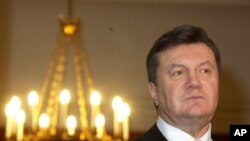
One year after Viktor Yanukovych became president of Ukraine, his boosters say he has brought stability to this massive nation of 46 million people. His critics say he is pushing Ukraine in an authoritarian direction, halfway toward Vladimir Putin's strong rule in Russia.
The euphoria of Ukraine's 2004 Orange Revolution fizzled during five years of political gridlock. One year ago, Ukrainians voted narrowly for a switch.
The winner of the Orange Revolution, pro-Western populist Yulia Tymoshenko, is out. The loser of the Orange Revolution, pro-Russian conservative Viktor Yanukovych, is in.
At stake is the direction of a post-Soviet state, second in size and population only to Russia.
In one-year report cards, freedom and democracy advocacy groups say President Yanukovych is taking Ukraine down an authoritarian path.
The U.S.-based organization Freedom House has downgraded Ukraine from free to partly free. Paris-based Reporters Without Borders dropped Ukraine 42 notches in its Media Freedom Index to 131st place.
Nataliya Lygachova works with the new Stop Censorship movement in Kyiv. She says Ukraine's new government borrowed from the Kremlin the strategy of imposing controls on television news. Newspaper and Internet sites are freer, but watched.
Theater student Anya Kovalenko says that Ukraine does not have the press freedom it had one year ago. She says that day and night, Ukrainian TV stations and newspapers say life here is better. But in reality, prices are rising and wages are frozen.
In response, Ukrainian diplomats increasingly are on the defensive. Foreign Ministry spokesman Oleh Voloshyn says many journalists and human rights workers in Ukraine are Orange Revolution supporters. The power shift came as a shock.
"When you live in a state of chaos, of political chaos, that we have been living through the past five years, any limitation of this chaos creates a feeling, especially for the journalists, of limits being put on the freedom of the press," said Voloshyn.
The U.S. Embassy in Kyiv recently warned President Yanukovych about selective persecution of political opponents. And the European Union has made it clear that democracy is a core condition for Ukraine winning a free trade pact this year.
These warnings came after prosecutors jailed three former ministers and prompted a fourth to flee to Prague and ask for asylum. Prosecutors also are interrogating Ms. Tymoshenko, the former prime minister, on charges of abuse of power. She is banned from leaving the country.
Ms. Tymoshenko said President Yanukovych "naïvely thinks he can build a new iron curtain. This is a man still living according to Soviet ways, with Soviet views."
Ms. Tymoshenko commented at her political headquarters a few hours after government security agents demanded her party's computer server. She calls President Yanukovych a tyrant.
She says the president's authoritarian ways are causing him to sink in opinion polls.
Foreign Ministry spokesman Voloshyn says politicians the world over are investigated for corruption after leaving office.
"How can we talk about political persecution? Her ratings increase, she organizes rallies, she meets with foreign journalists, she gives interviews," Voloshyn noted.
Many Ukrainians ask if President Yanukovych will move Ukraine further in the political direction of Vladimir Putin's Russia.
Russian journalist Evgeniy Kiselev is not worried. He hosts a political talk show in Kyiv, where he finds press freedom more robust than in Russia. He compares Ukraine to Belgium or Canada, other countries too linguistically and ethnically divided to be run by a centralizing strong man.
"This regionalization of Ukraine, I am not saying disintegration, the fact that Ukraine is a combination of different regions, groups, religions, interests, etcetera, is a blessing for the country," said Kiselev. "I don't think Putin's scenario is plausible for Ukraine. In Ukraine, this will never happen for many reasons."
As for Ukraine's political future, Kiselev predicts Mr. Yanukovych will face strong opposition candidates in the next presidential election, four years from now. And at this point, he says, he would not vouch for the president's re-election.