


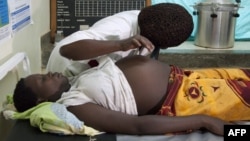
KAMPALA, Uganda — Without basic ultrasound machines, many of Uganda’s health centers cannot anticipate when a pregnant woman will face complications giving birth, contributing to the country's high maternal and child mortality rates.
According to the United Nations Children’s Fund, for every 1,000 live births, at least 63 infants die before their first birthday in Uganda. Many of those deaths come from complications that could have been predicted by ultrasound technology. The situation also contributes to the country’s high infant mortality rate, with 310 out of every 100,000 women dying in childbirth.
But an expanding project is helping get ultrasound technology into Ugandan health centers.
Until two years ago, health workers at Kamuli Mission Hospital could not even tell a woman if she was carrying twins because there were no ultrasound machines. As a result, women and their families would not know they needed to be near health facilities that can handle complicated pregnancies when it came time to give birth.
Now Kamuli hospital is the pilot site for Imaging the World, or ITW. The project provides low-cost ultrasound equipment and a basic training program that allows even low-level health workers to take basic scans.
After the images are taken at Kamuli, they are compressed and distributed via text message or e-mail to district-level health workers, who examine the images and identify potential problems. Specialists in the United States provide backup opinions. Health workers are informed early enough that a woman facing a difficult birth can be directed to a higher-level health facility.
Dr. Alphonsus Matovu, the medical director of the private Kamuli hospital, says the ITW project is working.
“You can easily catch pregnancies which would have resulted into bad outcomes and you can plan for an early intervention… which can help you save the life of the mother and the life of the baby," Matovu said. "And, these are the experiences that we have had since we began the ITW project.”
Dr. Kristen DeStigter, a co-founder of ITW and professor of radiology at the University of Vermont, says a combination of affordable Internet, reliable cell phone coverage and portable ultrasound equipment make the project feasible.
“We have the technology now and the time is right and I think that’s really what is motivating this project and the people who are a part of it," said DeStigter.
The cost of setting up the program in a health center is about $10,000. Last week, ITW finished installing new projects at eight additional health centers.
At Kamuli, DeStigter says the biggest surprise for her is what she calls the "magnet" effect. As women come for ultrasounds, they are staying at health facilities to be screened for malaria, anemia, HIV and other potential health and pregnancy complications.
ITW is featured as part of the Philips company’s Cairo to Cape Town Road Show. A team from the electronics multinational is touring Africa to highlight the work of some of the maternal and child health innovations it is supporting. The company has provided eight of ITW’s ultrasound machines.
With its success in Uganda, ITW is now considering expanding to sites in South America and Asia.
According to the United Nations Children’s Fund, for every 1,000 live births, at least 63 infants die before their first birthday in Uganda. Many of those deaths come from complications that could have been predicted by ultrasound technology. The situation also contributes to the country’s high infant mortality rate, with 310 out of every 100,000 women dying in childbirth.
But an expanding project is helping get ultrasound technology into Ugandan health centers.
Until two years ago, health workers at Kamuli Mission Hospital could not even tell a woman if she was carrying twins because there were no ultrasound machines. As a result, women and their families would not know they needed to be near health facilities that can handle complicated pregnancies when it came time to give birth.
Now Kamuli hospital is the pilot site for Imaging the World, or ITW. The project provides low-cost ultrasound equipment and a basic training program that allows even low-level health workers to take basic scans.
After the images are taken at Kamuli, they are compressed and distributed via text message or e-mail to district-level health workers, who examine the images and identify potential problems. Specialists in the United States provide backup opinions. Health workers are informed early enough that a woman facing a difficult birth can be directed to a higher-level health facility.
Dr. Alphonsus Matovu, the medical director of the private Kamuli hospital, says the ITW project is working.
“You can easily catch pregnancies which would have resulted into bad outcomes and you can plan for an early intervention… which can help you save the life of the mother and the life of the baby," Matovu said. "And, these are the experiences that we have had since we began the ITW project.”
Dr. Kristen DeStigter, a co-founder of ITW and professor of radiology at the University of Vermont, says a combination of affordable Internet, reliable cell phone coverage and portable ultrasound equipment make the project feasible.
“We have the technology now and the time is right and I think that’s really what is motivating this project and the people who are a part of it," said DeStigter.
The cost of setting up the program in a health center is about $10,000. Last week, ITW finished installing new projects at eight additional health centers.
At Kamuli, DeStigter says the biggest surprise for her is what she calls the "magnet" effect. As women come for ultrasounds, they are staying at health facilities to be screened for malaria, anemia, HIV and other potential health and pregnancy complications.
ITW is featured as part of the Philips company’s Cairo to Cape Town Road Show. A team from the electronics multinational is touring Africa to highlight the work of some of the maternal and child health innovations it is supporting. The company has provided eight of ITW’s ultrasound machines.
With its success in Uganda, ITW is now considering expanding to sites in South America and Asia.