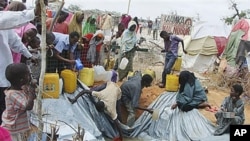
The United Nations’ humanitarian coordinator for Somalia Tuesday kicked off an annual appeal to assist Somalis affected by drought and war.
Mark Bowden terms Somalia’s combination of drought and warfare the most “complex and acute” crisis in the world, affecting four million people.
“We are literally on a knife-edge this year, said Bowden. "And if we do not sustain our operations, I think we could see serious problems develop [in] the areas that have recovered, perhaps moving back into famine-like conditions and also increasing displacement.”
The 2012 Somalia Consolidated Appeal Process, or CAP, is asking global donors for $1.5 billion to fund 350 projects operated by 148 humanitarian organizations. These include U.N. agencies as well as national and international aid groups.
U.N. Coordinator Bowden, launching the appeal in Nairobi Tuesday, says the focus this year is to continue to support life-saving activities and longer-term measures such as access to food at reasonable prices.
“We have, I think, a robust strategy," said Bowden. "This year, we will have to look at the issue of what we call ‘resilience.’ Basically, it is important that in our actions we try to preserve or re-establish peoples’ livelihoods to stop the long-term problems of displacement in Somalia that have been a critical factor for so long.”
Bowden called donors’ response to the 2011 appeal “outstanding” in the face of famine declared earlier this year in six parts of southern Somalia.
The 2012 appeal comes at a particularly difficult time in Somalia’s history.
The militant group al-Shabab, which has been battling African Union troops supporting the transitional government, last month banned 16 international aid agencies from operating in the territories it controls. Al-Shabab accused the agencies of spying on behalf of Western entities.
But despite the ban, Bowden and sources on the ground say aid still gets through to affected populations.
The director of a Somali aid group called General Services Agency, who gives his first name as being Elias, explains how.
"It is workable," said Elias. "CAP funding can be pulled into Somalia. It can be implemented by national agencies if international agencies cannot come into Somalia and operate freely. National agencies can play the role of western agencies and deliver the humanitarian assistance.”
The United Nations says 250,000 people in Somalia are still facing famine, 450,000 children are acutely malnourished, and almost 300,000 Somalis fled hunger and warfare in 2011.
UN Launches Annual $1.5 Billion Appeal for Somalia