



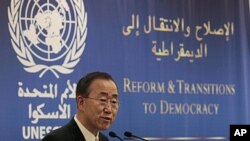
U.N. Secretary-General Ban Ki-moon issued a call to Syria's embattled President Bashar al-Assad Sunday to stop killing his own people.
In a keynote address at a conference in Lebanon focused on democracy in the Arab world, Ban said "the path of repression is a dead end."
Ban told those in attendance in Beirut that the Arab world's revolutions show that people there are no longer content with one-man rule.
"From the very beginning of the year's, last year's revolutions, from Tunisia through Egypt and beyond, I called on leaders to listen to their people, listen to the genuine aspirations of their people, what they need, and what are their voices," he said.
"Some did and benefited; some didn't, and today they are reaping the whirlwind. Today, I say again to President Assad of Syria: Stop the violence. Stop killing your own people. The path of repression is a dead end. The lessons of the past year are eloquent and clear. The winds of change will not cease to blow. The flame ignited in Tunisia will not be dimmed."
He also called for an end to Israeli "occupation" in the Arab world, saying settlements - new and old - are "illegal."
Meanwhile, Syria's officials SANA news agency said Assad has granted a general amnesty for crimes committed since the outbreak of the 10-month uprising against his rule. No other details were given.
The United Nations says more than 5,000 people have died in Syria since the uprising began last March. Meanwhile, Syrian authorities blame what they call "armed terrorists" for killing some 2,000 members of the security forces.
In an interview to be broadcast later Sunday in the United States on the television network CBS, the emir of Qatar, Sheikh Hamad bin Khalifa al-Thani, proposes sending Arab troops to Syria to halt the bloodshed in that country.
The emir is the first Arab leader to publicly support Arab military intervention in Syria, where protesters are demanding President Assad's resignation. The emir said the Arab League observer mission, sent to Syria on December 26, has made mistakes, and that U.N. assistance is needed to improve the monitoring of the Damascus government.
In the latest clashes Saturday, the British-based Syrian Observatory for Human Rights said several people were killed in different parts of the country, including a 13-year-old boy and a 27-year-old man in the flashpoint city of Homs.
| Join the conversation on our social journalism site - Middle East Voices. Follow our Middle East reports on Twitter and discuss them on our Facebook page. |