


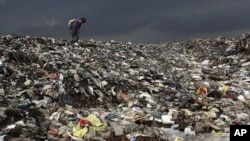
GENEVA - The United Nations is warning the world is doing a terrible job of managing the environment and conserving its precious resources for future generations. The U.N. Environment Program is launching its most comprehensive assessment of the state of the global environment before the Sustainable Development Conference that opens next week in Rio de Janeiro.
The report finds the world is continuing to speed down an unsustainable path, despite more than 500 internationally agreed goals and targets aimed at conserving the environment and improving human wellbeing.
The just released fifth edition of the Global Environmental Outlook assesses 90 of the most-important environmental goals and objectives. UNEP Regional Director for Europe, Jan Dusik, says of these significant progress has been made in only four.
"These are eliminating the production and use of substances that deplete the ozone layer, the removal of lead from fuel, increasing access to improved water supplies and boosting research to reduce pollution of the marine environment," said Dusik. "Some progress was shown in 40 goals, including the expansion of protected areas such as National Parks and efforts to reduce deforestation. Little or no progress was detected for 24 of the goals, which include climate change, fish stocks, and desertification and drought."
Among its key findings, the report says Africa, Asia and the Pacific, and Latin America and the Caribbean share the common problems of population growth and increasing consumption. It says these are worsened by rapid urbanization in Africa and Asia and the Pacific. This, in turn, places growing stress on dwindling natural resources. It cites climate change as an overarching problem.
The report notes Europe and North America continue to operate at unsustainable levels of consumption, and North America in particular is slow in developing a renewable energy industry.
UNEP finds West Asia is facing worsening water scarcity, land degradation and sea level rise. But, it points out that Yemen, Saudi Arabia and Bahrain manage their water resources well and it praises Syria's rangeland rehabilitation policy. ((END OPT ))
UNEP Division of Early Warning and Assessment Regional Coordinator for Europe Ron Witt says the report finds humans for the first time are overwhelming the forces of nature and the ability of the planet to cope with pressures on the natural environment.
Witt says the report analyzes the major driving forces behind global environmental change.
"In particular, we cite two major driving forces, which we really need to turn around if the world is going to survive until the 22nd century," Witt added. "The first of these is sheer human overpopulation of the planet ... and the second issue is the over consumption by the growing human population, which, of course, is exhausting the resource base of the planet earth. It is these underlying driving forces, which need to be addressed rather than simply the resulting pressures or impacts, which are the symptoms of the driving... forces as they manifest themselves, if we want to collectively counteract the deteriorating state of the planetary environment."
Witt says the world simply cannot continue business as usual. He says major changes in society's behavior must be made or the Earth will face greater problems in the future.
The report says the race for development does not have to be at the expense of the environment or the populations, which rely on it.
Among its recommendations, the report says more reliable data are needed to make informed decisions about environmental resources. It says there needs to be clear long-term environment and development targets, and stronger accountability in international agreements.
The report finds the world is continuing to speed down an unsustainable path, despite more than 500 internationally agreed goals and targets aimed at conserving the environment and improving human wellbeing.
The just released fifth edition of the Global Environmental Outlook assesses 90 of the most-important environmental goals and objectives. UNEP Regional Director for Europe, Jan Dusik, says of these significant progress has been made in only four.
"These are eliminating the production and use of substances that deplete the ozone layer, the removal of lead from fuel, increasing access to improved water supplies and boosting research to reduce pollution of the marine environment," said Dusik. "Some progress was shown in 40 goals, including the expansion of protected areas such as National Parks and efforts to reduce deforestation. Little or no progress was detected for 24 of the goals, which include climate change, fish stocks, and desertification and drought."
Among its key findings, the report says Africa, Asia and the Pacific, and Latin America and the Caribbean share the common problems of population growth and increasing consumption. It says these are worsened by rapid urbanization in Africa and Asia and the Pacific. This, in turn, places growing stress on dwindling natural resources. It cites climate change as an overarching problem.
The report notes Europe and North America continue to operate at unsustainable levels of consumption, and North America in particular is slow in developing a renewable energy industry.
UNEP finds West Asia is facing worsening water scarcity, land degradation and sea level rise. But, it points out that Yemen, Saudi Arabia and Bahrain manage their water resources well and it praises Syria's rangeland rehabilitation policy. ((END OPT ))
UNEP Division of Early Warning and Assessment Regional Coordinator for Europe Ron Witt says the report finds humans for the first time are overwhelming the forces of nature and the ability of the planet to cope with pressures on the natural environment.
Witt says the report analyzes the major driving forces behind global environmental change.
"In particular, we cite two major driving forces, which we really need to turn around if the world is going to survive until the 22nd century," Witt added. "The first of these is sheer human overpopulation of the planet ... and the second issue is the over consumption by the growing human population, which, of course, is exhausting the resource base of the planet earth. It is these underlying driving forces, which need to be addressed rather than simply the resulting pressures or impacts, which are the symptoms of the driving... forces as they manifest themselves, if we want to collectively counteract the deteriorating state of the planetary environment."
Witt says the world simply cannot continue business as usual. He says major changes in society's behavior must be made or the Earth will face greater problems in the future.
The report says the race for development does not have to be at the expense of the environment or the populations, which rely on it.
Among its recommendations, the report says more reliable data are needed to make informed decisions about environmental resources. It says there needs to be clear long-term environment and development targets, and stronger accountability in international agreements.