Since the first meeting of this every 10-year event in 1971, the number of least-developed countries has increased, and U.N. officials say the population of the world's 48 poorest nations is expected to double to 1.7 billion by 2050.
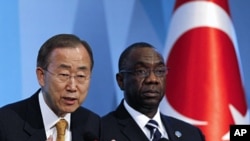
Addressing this year's conference in Istanbul, U.N. Secretary-General Ban Ki-moon says more strain is being placed on essential services, such as food availability.
"Global food prices are at record new levels. [Least Developed Countries] face a real prospect of a new crisis [in] food and nutrition security," said the U.N. secretary-general. "In many LDC's [people] spend more than half of their incomes on food."
World Bank Managing Director Ngozi Okonjo-Iweala says the European Union can play a key role in helping food markets work better.
"We really need to watch that this food crisis does not turn into a sort of global crisis. Often in the world it is not that there is [not] enough food, we just do not have enough information on the where there is food at any one time, so that we can distribute it from food surplus to food deficit areas," said Okonjo-Iweala. "And we need to invest in safety nets to cushion the most vulnerable, those who do not have access to land, so there is plenty of scope for the European Union."
Speculation in the international commodity market also is cited by many as contributing to high food prices.
France is the current chair of the G20 organization of leading economies, and French Development Minister Henri de Raincourt says bringing commodity speculators under control is a key priority.
He says market volatility is one of the most important issues at this time, and France plans to seek a concrete means of stabilizing prices and raising production levels when it hosts the G20 summit in November in Cannes.
How France proposes to curtail commodity speculation remains unclear, but critics say controlling the world markets is difficult and can make matters worse.
Okonjo-Iweala says speculation is more a symptom than a cause.
"The demand for food is going up, because world population is going up, and also the quality of the demand is shifting because in terms of fact people are demanding more meat and dairy products, which again requires more feed," said Okonjo-Iweala. "There is also the demand for biofuels which fits into it. So if you put all this together, speculation is part of that basket. But there are some longer-term trends we need to watch."
But Raincourt warns rising food prices could soon become not only an economic crisis for the poor, but a crisis for Europe.
He says, "We have already seen food riots in Africa, but this is nothing to what is coming."
Raincourt says some people will leave their countries and migrate to Europe, putting more pressure on its borders, and becoming a humanitarian, social, economic and global security crisis.
UN: Food Prices Deepening Global Poverty