


A United Nations report to be issued this week accuses President Bashar al-Assad’s Syrian government of using its military and an allied militia, the shabiha, to commit war crimes and crimes against humanity to help the regime stay in power.
The document, entitled the Syria report, says the Syrian opposition also has committed rights violations during the uprising that started a year and a half ago, but concludes the government and its allies have been the main perpetrators.
The report is to be presented to the U.N. Human Rights Council by the U.N. High Commissioner for Human Rights, Navi Pillay. The Human Rights Council opened a three-week meeting in Geneva on Monday.
A panel of U.N.-appointed independent commissioners listened to more than 1,000 accounts of murder, extrajudicial killings, sexual violence and torture during its investigation of human rights violations and war crimes in Syria over the past 18 months.
The panel’s report places part of the blame for the violations on units of the loosely organized Free Syrian Army rebels. But most of panel’s accusations of criminal acts are leveled at President Assad’s military and the much feared shabiha militia – pro-government enforcers closely tied to the Assad regime and its supporters in the Alawite community.
“The commission finds reasonable grounds to believe that crimes against humanity, breaches of international humanitarian law and gross human rights violations have been committed in the Syrian Arab Republic,” the report says.
“The shabiha were identified as perpetrators of many of the crimes” said the report, which includes a confidential list of suspected individuals and units.
Karen Koning AbuZayd, one of the commissioners investigating evidence in the Syria violence, described the panel’s investigation and the prominence of testimony against the shabiha.
”As some of the defectors said, they [the shabiha] go in to clean up and get rid of many of the people who they can identify to be murdered,” she said.
This is the commission’s third report. AbuZayd said a fourth is likely.
Assad leans more on Alawi shabiha
For more than a year, protest organizers and citizen journalists have reported a large number of non-uniformed combatants known as shabiha, who accompany regular Syrian army units attacking communities sympathetic to the revolution or act as eager enforcers at military and police checkpoints.
According to August 1 testimony by Martin Indyk, foreign policy director for the Brookings Institution, there were at the time several thousand shabiha.
“With their backs to the wall, the Alawite regime considers its choice as binary – either kill or be killed,” Indyk told the U.S. Senate’s Committee on Foreign Relations.
In addition to the government’s estimated 300,000-member military, Indyk cited “a paramilitary force – the feared ‘shabiha’ [ghosts] – of several more thousand…”
Recent reports indicate that as Sunni Muslims defected from the Syrian military, the Assad regime is increasingly filling the vacancies with Alawites, many who have previously served in the nation’s conscript army.
Jeffrey White, a military analyst at the Washington Institute for Near East Policy in Washington, D.C., recently returned from meeting with military defectors and Free Syrian Army rebel commanders.
“One of the things we heard when we were out in Turkey,” said White, “is that, in fact, the government had mobilized retired military officers to train the shabiha, that they have a training camp and headquarters, that there is some sort of organizational structure for them…”
Houla massacre
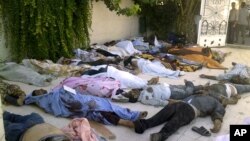
The U.N. panel singled out the Assad regime and its Alawite supporters in a massacre of more than 100 people last May in the small town of Taldou in al-Houla.
Contemporary accounts of the incident described Taldou as a village of Sunnis surrounded by several villages of Alawites who are believed to have helped the government to invade the village in search of rebels. Until recent reports of deaths in the Damascus suburb of Daraya, the Houla massacre captured the attention of the world.
The panel found that most of the fatalities were the result of summary executions by armed civilians accompanying military troops. According to the U.N. report, for example, 60 members of one family, the Abdulrazzaks, were killed in broad daylight on May 25.
The commission examined but dismissed the regime’s own investigation and claim that anti-government forces were to blame.
The U.N. inquiry is based on satellite imagery of the village and telephone conversations with six witnesses in the village. The commissioners said the deaths of members of two extended families were politically motivated.
Ghosts in a shifting culture of violence
However, much of the testimony about shabiha violence involves perpetrators without names. And in Syria’s current lawlessness, the acts of local armed defense councils, shabiha and common criminals may look alike, according to commission member AbuZayd.
The image of the shabiha has been blurred in international media as well.
“The groups referred to as shabiha by the Arab satellite news channels are a different breed altogether: violent ex-offenders and outlaws who enjoy a complex relationship with the mukhabbarat [secret police] and police officers, who run them and share in the profits of their criminal enterprise,” writes Damascus journalist Yassin al-Haj Salih.
Even so, the threat of the shabiha remains strong. Shortly after he published an analysis of the shabiha in a Heinrich Boll Foundation publication, Salih felt it necessary to go into hiding and declined further interviews on the subject.
Could the shabiha be tried in the Hague?
AbuZayd said there is concern that while the shabiha’s criminal activities are well-documented, more evidence needs to be developed on the identities of the shabiha members who commit them.
White said, “I think there’s more structure, more organization than we know. We see that the shabiha are cooperating directly with regime forces. They ride with the tanks; they use them in combat; they use them as light infantry. The regular army and the shabiha are working together.
“It should not be an overwhelming obstacle to bring some of these guys to trial,” said White. “For one thing, the opposition knows who these guys are by name. The names of shabiha people and commanders, the opposition is going to know that.”
In addition to testimony from shabiha victims, defectors who managed units of shabiha confirmed the government role to the U.N. commissioners. “That’s why we are able to say we think what is going on is a product of state policy. Someone is controlling this,” AbuZayd said.
“With shabiha, it’s hard to tell, but people describe them pretty consistently, I would say, and our information comes from victims who say, ‘The shabiha did this to us.’”
The document, entitled the Syria report, says the Syrian opposition also has committed rights violations during the uprising that started a year and a half ago, but concludes the government and its allies have been the main perpetrators.
The report is to be presented to the U.N. Human Rights Council by the U.N. High Commissioner for Human Rights, Navi Pillay. The Human Rights Council opened a three-week meeting in Geneva on Monday.
A panel of U.N.-appointed independent commissioners listened to more than 1,000 accounts of murder, extrajudicial killings, sexual violence and torture during its investigation of human rights violations and war crimes in Syria over the past 18 months.
“The shabiha were identified as perpetrators of many of the crimes …”Commission of Inquiry report
The panel’s report places part of the blame for the violations on units of the loosely organized Free Syrian Army rebels. But most of panel’s accusations of criminal acts are leveled at President Assad’s military and the much feared shabiha militia – pro-government enforcers closely tied to the Assad regime and its supporters in the Alawite community.
“The commission finds reasonable grounds to believe that crimes against humanity, breaches of international humanitarian law and gross human rights violations have been committed in the Syrian Arab Republic,” the report says.
“The shabiha were identified as perpetrators of many of the crimes” said the report, which includes a confidential list of suspected individuals and units.
Karen Koning AbuZayd, one of the commissioners investigating evidence in the Syria violence, described the panel’s investigation and the prominence of testimony against the shabiha.
”As some of the defectors said, they [the shabiha] go in to clean up and get rid of many of the people who they can identify to be murdered,” she said.
This is the commission’s third report. AbuZayd said a fourth is likely.
Assad leans more on Alawi shabiha
For more than a year, protest organizers and citizen journalists have reported a large number of non-uniformed combatants known as shabiha, who accompany regular Syrian army units attacking communities sympathetic to the revolution or act as eager enforcers at military and police checkpoints.
We see that the shabiha are cooperating directly with regime forces. They ride with the tanks; they use them in combat; they use them as light infantry.Jeffrey White, Washington Institute for Near East Policy
According to August 1 testimony by Martin Indyk, foreign policy director for the Brookings Institution, there were at the time several thousand shabiha.
“With their backs to the wall, the Alawite regime considers its choice as binary – either kill or be killed,” Indyk told the U.S. Senate’s Committee on Foreign Relations.
In addition to the government’s estimated 300,000-member military, Indyk cited “a paramilitary force – the feared ‘shabiha’ [ghosts] – of several more thousand…”
Recent reports indicate that as Sunni Muslims defected from the Syrian military, the Assad regime is increasingly filling the vacancies with Alawites, many who have previously served in the nation’s conscript army.
Jeffrey White, a military analyst at the Washington Institute for Near East Policy in Washington, D.C., recently returned from meeting with military defectors and Free Syrian Army rebel commanders.
“One of the things we heard when we were out in Turkey,” said White, “is that, in fact, the government had mobilized retired military officers to train the shabiha, that they have a training camp and headquarters, that there is some sort of organizational structure for them…”
Houla massacre
The U.N. panel singled out the Assad regime and its Alawite supporters in a massacre of more than 100 people last May in the small town of Taldou in al-Houla.
Contemporary accounts of the incident described Taldou as a village of Sunnis surrounded by several villages of Alawites who are believed to have helped the government to invade the village in search of rebels. Until recent reports of deaths in the Damascus suburb of Daraya, the Houla massacre captured the attention of the world.
The panel found that most of the fatalities were the result of summary executions by armed civilians accompanying military troops. According to the U.N. report, for example, 60 members of one family, the Abdulrazzaks, were killed in broad daylight on May 25.
The commission examined but dismissed the regime’s own investigation and claim that anti-government forces were to blame.
The groups referred to as shabiha by the Arab satellite news channels are a different breed altogether: violent ex-offenders and outlaws who enjoy a complex relationship with the mukhabbarat...Yassin al-Haj Salih
The U.N. inquiry is based on satellite imagery of the village and telephone conversations with six witnesses in the village. The commissioners said the deaths of members of two extended families were politically motivated.
Ghosts in a shifting culture of violence
However, much of the testimony about shabiha violence involves perpetrators without names. And in Syria’s current lawlessness, the acts of local armed defense councils, shabiha and common criminals may look alike, according to commission member AbuZayd.
The image of the shabiha has been blurred in international media as well.
“The groups referred to as shabiha by the Arab satellite news channels are a different breed altogether: violent ex-offenders and outlaws who enjoy a complex relationship with the mukhabbarat [secret police] and police officers, who run them and share in the profits of their criminal enterprise,” writes Damascus journalist Yassin al-Haj Salih.
Even so, the threat of the shabiha remains strong. Shortly after he published an analysis of the shabiha in a Heinrich Boll Foundation publication, Salih felt it necessary to go into hiding and declined further interviews on the subject.
Could the shabiha be tried in the Hague?
AbuZayd said there is concern that while the shabiha’s criminal activities are well-documented, more evidence needs to be developed on the identities of the shabiha members who commit them.
White said, “I think there’s more structure, more organization than we know. We see that the shabiha are cooperating directly with regime forces. They ride with the tanks; they use them in combat; they use them as light infantry. The regular army and the shabiha are working together.
“It should not be an overwhelming obstacle to bring some of these guys to trial,” said White. “For one thing, the opposition knows who these guys are by name. The names of shabiha people and commanders, the opposition is going to know that.”
In addition to testimony from shabiha victims, defectors who managed units of shabiha confirmed the government role to the U.N. commissioners. “That’s why we are able to say we think what is going on is a product of state policy. Someone is controlling this,” AbuZayd said.
“With shabiha, it’s hard to tell, but people describe them pretty consistently, I would say, and our information comes from victims who say, ‘The shabiha did this to us.’”