


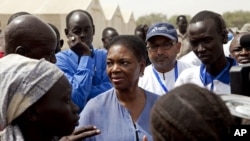
KINSHASA—The United Nations’ top official for humanitarian affairs, Valerie Amos, is in the Democratic Republic of Congo for a three-day tour. She says she wants to see for herself how aid workers are coping with a growing humanitarian crisis in eastern provinces.
Amos spent much of Monday talking to government officials in Kinshasa. Tuesday, she flies to North Kivu province where fighting in the past three months has increased the already-large number of displaced people.
A spokesman for the U.N. Office for the Coordination of Humanitarian Affairs, Yvon Edoumou, says that since April around 275,000 people have been forced to flee their homes by fighting between the government and rebels in North Kivu province. He said health services have been severely disrupted and many schools badly damaged.
"There are other issues of concern; for example the number of schools that have been either looted or destroyed or damaged as a result of fighting," said Edoumou. "We’re talking about around 258 schools which means that starting next year, the next school year, as many as 60,000 children could be out of school."
He said the damage to schools was due to a combination of factors, including armed groups looting schools and displaced people squatting in them.
The U.N. and NGOs have appealed for a total of $791 million for humanitarian aid to the DR Congo this year, but they are a long way from securing that funding.
"Now as of today we’re at about 41, 42 percent of what we would like to have, so we are eight months into the year and we’re not yet at 50 percent and that is not boding well for us," he said. "So there is a funding crisis and [that is] part of the reason that Mrs. Amos is here, is to raise that concern.
The majority of displaced people appear to have reached camps or makeshift sites where they can get some food aid and shelter. But Edoumou admits that aid workers can’t reach everyone.
"It’s clear that there are a number of displaced people who, because they may still be living in the bush, may not be receiving help," he said. "But all the NGOs and agencies, particularly WFP, the main food agency, have maintained operations distributing aid throughout the province to all those camps."
Insecurity has forced two health agencies to abandon operations in Walikale district, but otherwise Edoumou said aid workers are carrying on in North Kivu. He acknowledges, however, that workers have to think more about security when deciding where they can go.
Amos spent much of Monday talking to government officials in Kinshasa. Tuesday, she flies to North Kivu province where fighting in the past three months has increased the already-large number of displaced people.
A spokesman for the U.N. Office for the Coordination of Humanitarian Affairs, Yvon Edoumou, says that since April around 275,000 people have been forced to flee their homes by fighting between the government and rebels in North Kivu province. He said health services have been severely disrupted and many schools badly damaged.
"There are other issues of concern; for example the number of schools that have been either looted or destroyed or damaged as a result of fighting," said Edoumou. "We’re talking about around 258 schools which means that starting next year, the next school year, as many as 60,000 children could be out of school."
He said the damage to schools was due to a combination of factors, including armed groups looting schools and displaced people squatting in them.
The U.N. and NGOs have appealed for a total of $791 million for humanitarian aid to the DR Congo this year, but they are a long way from securing that funding.
"Now as of today we’re at about 41, 42 percent of what we would like to have, so we are eight months into the year and we’re not yet at 50 percent and that is not boding well for us," he said. "So there is a funding crisis and [that is] part of the reason that Mrs. Amos is here, is to raise that concern.
The majority of displaced people appear to have reached camps or makeshift sites where they can get some food aid and shelter. But Edoumou admits that aid workers can’t reach everyone.
"It’s clear that there are a number of displaced people who, because they may still be living in the bush, may not be receiving help," he said. "But all the NGOs and agencies, particularly WFP, the main food agency, have maintained operations distributing aid throughout the province to all those camps."
Insecurity has forced two health agencies to abandon operations in Walikale district, but otherwise Edoumou said aid workers are carrying on in North Kivu. He acknowledges, however, that workers have to think more about security when deciding where they can go.