


A report by the United Nations Office on Drugs and Crime (UNODC) warns that production and use of synthetic drugs such as amphetamine-type stimulants is widespread and growing globally. The report identifies Southeast Asia as a newly active source of illicit-substance manufacturing and trade.
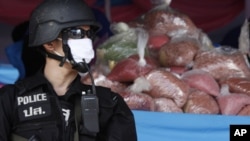
The report specifically identifies Indonesia, Malaysia and Cambodia as primary nodes of production and trafficking, but states that seizures of methamphetamine pills throughout Southeast Asia increased from 32 million in 2008 to 133 million in 2010.
It also says injected drug use is growing, adding to concerns about the spread of HIV and AIDS. UNODC regional representative Gary Lewis says production of amphetamine-type stimulants outside traditional sources such as Burma is also a new development.
“China and the Philippines are emerging as producers," he said, adding that Indonesia is becoming a potential source of ecstasy for the entire region.
He said strategies to reduce illicit drugs need to focus on public health issues rather than re-mobilization of so-called "war on drugs" policies.
"Things happen with respect to that phrase that are not helpful for public health or for public security," he said. "Containing the drug problem has worked over the past decade."
Thailand Prime Minister Yingluck Shinawatra says she will renew policies of aggressively combating illicit drugs by targeting criminal gangs and tightening cross-border commerce in order to stanch the flow of drugs from factories in eastern Burma.
Thailand faced international criticism over a similar campaign in 2003 that was executed by Yingluck’s older brother, former Prime Minister Thaksin Shinawatra. During that crackdown, more than 3,000 people died and rights groups accused authorities of allowing extrajudicial killings. Yingluck says the current policy will also focus on treatment.
U.S. Assistant Secretary of State William Brownfield, head of the Bureau of International Narcotics and Law Enforcement Affairs, said new campaigns must learn from past experiences.
"One rule we obviously have learned is that combating drugs must be done in a way that respects the rights, needs, hopes and aspirations of the communities that we are serving," he said.
Programs of eradication and crop substitution have led to sharp reductions illicit-drug output in Thailand, Laos and Burma, the so-called “golden triangle” of opium and heroin production.
Brownfield added that Afghanistan, which eclipsed Burma as the world's largest producer of opium in 1992, is already in crosshairs of international authorities.
"As Afghanistan comes under increasing pressure to reduce its production and export of illicit drugs," he said, "drug-trafficking gangs will look to another country to produce and export drugs and the most logical country in this region of Asia is Burma."
The report also says that on a global basis, amphetamine-type stimulants are now the second most widely used illicit drugs after cannabis.