



News / Asia

Crews Race To Supply Emergency Power To Crippled Japanese Plant

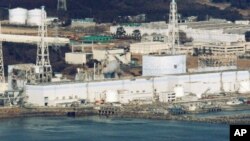
Reactors 1 to 4 (from R to L) of the Fukushima Daiichi nuclear power plant in Fukushima are seen in this picture taken more than 30km (18 miles) offshore from the site shortly before the start of the water-dropping operation, March 17, 2011

Japanese engineers are racing Friday to extend an emergency power cable to a nuclear reactor complex crippled by the country's earthquake and tsunami a week ago.

A steady supply of power could enable workers at the Fukushima plant to get water pumps working again in their urgent effort to cool off overheated nuclear fuel rods.

The International Atomic Energy Agency says that Japanese authorities have told them they have been able to lay a cable line to reactor number two at the nuclear plant.  However, it is not clear how close workers are to actually restoring power.

The U.N. nuclear agency reported the situation at the Fukushima nuclear station was "very serious" Thursday, but that the problems caused by last week's natural disaster had not become significantly worse during the previous 24 hours.  That assessment was delivered before the announcement late Thursday night that the circuit delivering electric power to the plant had just been restored.


In Vienna, an official at the International Atomic Energy Agency, Graham Andrew, told reporters radiation levels had risen "significantly" in some locations up to 30 kilometers away from the Fukushima plant.  However, in Tokyo, 240 kilometers away, radiation levels have been well below levels considered dangerous to human health.

In Washington, top U.S. military officials at the Pentagon said they are sending a nine-member team of experts to evaluate how the U.S. can help Japan deal with its nuclear crisis.

The risk of radiation poisoning has already forced the evacuation of more than 200,000 people who lived within 20 kilometers of the reactor site.  Many are in makeshift shelters, with inadequate food, water and other supplies, in frigid winter weather.

For anyone still living inside a wider radius from the plant - 30 kilometers - Japanese authorities said everyone should remain indoors and take measures to minimize the amount of outside air entering their living quarters.

And Japan's Kyodo news agency reported late Thursday that a new government directive would instruct local officials to begin testing for radioactivity in domestically produced food.

Japanese authorities have promoted the idea that a restored water-pumping system can ease overheating at the reactors, but the government's chief  spokesman, Yukio Edano, warned that even then, seawater has corroded much of the original pump system and it will have to be replaced.

Three of the Fukushima plant's six reactors were operating when the quake struck, while three others were shut down for maintenance. Explosions have rocked all three of the three units that had been in operation, causing varying degrees of damage to the elaborate systems meant to contain the reactor's core material and prevent a runaway nuclear reaction.

With those fears in mind, the Japanese military used high-pressure fire hoses early Thursday in a desperate attempt to douse nuclear fuel rods that have been overheating since the March 11 earthquake disabled the 40-year-old nuclear plant's cooling systems.  If the rods become hot enough, the greatest danger is that they could melt or burn through their outer casings, which would greatly increase the amount of radiation released into the atmosphere.

Japan also used aerial water drops from helicopters, but video of the operation showed most of the water fell far from the reactors' cooling tanks, and the effort was suspended after four attempts.

Extremely high radiation levels in the near vicinity of the reactors have made it impossible for workers to approach the facility for more than a few minutes at a time.

Greg Jaczko, head of the US Nuclear Regulatory Commission, said Thursday it would be a "prudent measure" for its citizens to follow US government advice to stay at least 80 kilometers from the plant -- a radius much larger than the Japanese exclusion zone. He described the situation at the Fukushima plant as "very dynamic."

Many governments are evacuating staff from embassies in Tokyo.  The United States has authorized the evacuation of family members and dependents of U.S. personnel, and promised, Thursday, that charter flights will be provide to help any Americans who want to leave Japan.

The prime minister's office warned of a "massive power outage" in the area served by the Tokyo Electric Power Company, TEPCO, and called on everyone in the country to conserve electricity.

Some information for this report provided by AFP, AP and Reuters.

You May Like

What You Need to Know About Benghazi Hearing

House committee on Benghazi was created in May 2014 to investigate causes of and responses to attacks on two US sites More

Will Cricket Score Points with Americans?

All-star cricket teams will hold matches in US cities in an attempt to spark American interest in the sport, which enjoys enormous popularity outside the US More

What Americans Fear More Than Terrorism

Americans are more afraid of this than they are of potential terrorist attacks, according to a new fear survey More

This forum has been closed.
Comments
     
There are no comments in this forum. Be first and add one

Featured Videos

Your JavaScript is turned off or you have an old version of Adobe's Flash Player. Get the latest Flash player.
Drug Kingpin El Chapo Guzman Injured During Searchi
X
Alberto Pimienta
October 19, 2015 8:34 PM
Mexican authorities are closing in on the most dangerous drug trafficker in the world, Joaquin “El Chapo” Guzman. “El Chapo” avoided being captured over the weekend but the Mexican government says he’s now injured. VOA's Alberto Pimienta reports.
Video

Video Drug Kingpin El Chapo Guzman Injured During Search

Mexican authorities are closing in on the most dangerous drug trafficker in the world, Joaquin “El Chapo” Guzman. “El Chapo” avoided being captured over the weekend but the Mexican government says he’s now injured. VOA's Alberto Pimienta reports.
Video

Video Kenyan Town Vies to Become East African Cycling Hub

The sport of cycling has steadily built a following in East Africa in recent years. It doesn’t hurt that two-time Tour de France winner Chris Froome was born in Kenya and trained by one of Africa’s best cyclists, David Kinjah. And now the town of Machakos, about 56 kilometers southeast of Nairobi, is trying to become Kenya’s, and perhaps East Africa’s, cycling hub. VOA’s Jill Craig has more from Machakos, Kenya.
Video

Video Taliban Remain Serious Threat in Provinces Around Kunduz

Even though Afghan security forces have regained control of the northern city of Kunduz from the Taliban after fierce fighting, the security situation in the region is still tenuous. VOA’s Ayesha Tanzeem traveled to Baghlan Province, neighboring Kunduz, and has this report on the situation there.
Video

Video Taiwan Finding Niche Markets in China’s Shadow

China’s economy is like a business magnet and as its influence grows its neighbors are finding it increasingly difficult to remain competitive. Like many economies in the region, Taiwan has been hit hard in recent years as China’s so-called “red-supply chain” has drained off talent and opportunities.
Video

Video Amid Congressional Leadership Crisis, Momentous US Fiscal Deadlines Loom

The U.S. Congress faces critical fiscal deadlines at a time of upheaval and uncertainty on Capitol Hill. Lawmakers are returning from a weeklong recess still wondering who will lead the House of Representatives. Michael Bowman reports.
Video

Video Egyptians Vote in Long-delayed Parliamentary Election

Voting in a long-awaited election for a new parliament opened Sunday in half of Egypt's provinces as the government works to complete a roadmap to democracy implemented following the ouster of the country's first freely elected civilian President Mohamed Morsi of the Muslim Brotherhood.
Video

Video Reparations Underway for War Victims in Ivory Coast, Many Still Awaiting

Five years after the deadly 2010 post-election violence in Ivory Coast, the country is determined to consolidate its peace. And to help in that reconciliation, President Alassane Ouattara created agencies aimed at providing reparation for war victims. The first batch of victims was compensated last August. But many are still waiting, and some are losing patience over the lagging process. Emilie Iob reports.
Video

Video Inter-Korean Family Reunions Preparations Under Way

A South Korean advance team that includes Red Cross officials is now in North Korea to prepare for next week’s reunion for families that have been separated by the Korean War. VOA’s Brian Padden reports from Seoul that this rare reunion, that just weeks ago looked unlikely to happen, will offer the 200 selected participants the first opportunity to see their families in over half a century. And it could clear the way to further inter-Korean cooperation.
Video

Video Vets: Syria Not Another Afghanistan for Russia

Russia's military strikes in Syria against enemies of President Bashar al-Assad have raised fears of a proxy war against U.S.-armed rebels. The concerns echo the Soviet Union's 1979 intervention in Afghanistan. Russian veterans of the Afghan War, however, say a similar conflict in Syria is unlikely as long as ground troops are not involved. VOA's Daniel Schearf reports from Moscow.
Video

Video Largest US Prisoner Release to Begin Oct. 30

The United States is beginning its largest prisoner release in history, now that federal sentencing guidelines have been reduced for certain drug offenders. VOA's Carolyn Presutti talks to an inmate who is counting down the days to freedom — and the people who don't think he's yet to earn it.
Video

Video Syrian Refugees in US Struggle to Start Anew

Communities across the United States are welcoming Syrian refugees who have fled their war-torn country and often spent many months, if not years, in refugee camps. But, as VOA’s Greg Flakus reports from Houston, some of their biggest challenges come as they try to adapt to life in a new country.
Video

Video Turkey: Europe’s Offer of Migrant Deal ‘Insincere’

European Union leaders have agreed on a plan to offer Turkey $3.5 billion, together with visa-free travel and renewed accession talks, in return for stopping the flow of refugees and migrants into the EU. But as Henry Ridgwell reports from London, the offer is getting a lukewarm reception in Ankara.
Video

Video Amnesty Accuses Saudi Coalition of ‘War Crimes’ in Yemen

The human rights group Amnesty International has accused the Saudi-led coalition of war crimes in airstrikes against Houthi rebels in Yemen. Henry Ridgwell reports the group says hundreds of civilians have been killed in strikes on residential areas.

VOA Blogs