News / Africa

UN: One-Third of Somalis Now Displaced

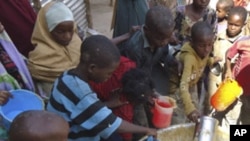
Children from southern Somalia get cooked food at a local NGO's compound in Mogadishu, Somalia, Sept.14, 2011.
TEXT SIZE - +

A new report says nearly one-third of Somalia's people are now displaced from their homes because of drought, famine, and years of war.

The U.N. humanitarian affairs office puts the number of displaced Somalis at 2.3 million - 1.4 million within the country, and 920,000 living as refugees in Kenya, Ethiopia, Djibouti, and Yemen.

It says one in every three of those people fled their homes within the last year.

The U.N. agency's report also says Somalis are crossing into Kenya at a rate of 1,200 per day as famine conditions continue to spread across southern Somalia.

The report details efforts to deliver food, shelter, and medicine to desperate Somalis, but warns the country still needs a "massive scale-up" in humanitarian aid.

It says 750,000 Somalis are at risk of death unless drought and famine relief efforts are increased.

Southern Somalia is at the center of the worst drought to hit the Horn of Africa in 60 years.  The drought compounded already tough conditions in the country, which has not had a stable central government since 1991.

The U.N. has declared six areas of the south to be famine zones, and international aid agencies have sent in large amounts of food aid, giving special attention to malnourished children.

But aid efforts have been hampered by lawlessness and a lack of security.  Militant group al-Shabab, which is fighting the Somali government, has blocked aid groups from operating in areas under its control.

The World Meteorological Organization recently forecast increased rains for southern Somalia but the U.N. warns the rains could bring more waterborne diseases in the congested refugee and displaced-person camps.


You May Like

India, China Pledge to Overcome Border Tensions

Indian prime minister and Chinese premier attempt to move past tense standoff in the Himalayas during Delhi talks More

Burmese President Opens US Visit with VOA Town Hall Meeting

Ahead of his meeting with President Obama Monday, Thein Sein answered questions on human rights and economic development in his country More

Video Washington Week: Focus on Burma, US Government Scandals

President Thein Sein visits the White House on Monday, Congressional probes of multiple scandals are continuing More

This forum has been closed.
Comments
     
There are no comments in this forum. Be first and add one

Featured Videos

Your JavaScript is turned off or you have an old version of Adobe's Flash Player. Get the latest Flash player.
Video

Video Boston Bomber Spent 6 Months in Russia’s Most Violent Republic

The news of the Boston Marathon bombings circled the globe, and resonated here in Dagestan, a majority Muslim republic in Russia, on the shores of the Caspian Sea. Last year, Tamerlan Tsarnaev, the older of two brothers suspected of the bombings and a long-time Boston resident, returned to Dagestan, where he had lived for a year during his youth. Dagestan was the land of his maternal ancestors. But in the last two years, this republic of 3 million people has gained notoriety as the region with the highest level of political and religious violence in all of Russia. VOA's James Brooke reports from Makhachkala, Russia.