



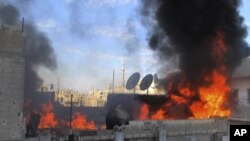
Diplomats say a group of Western and Arab-led nations gathering in Tunis to discuss Syria's worsening unrest may issue a demand for Damascus to allow the delivery of foreign humanitarian aid to hard-hit areas within days.
The officials say participants in Friday's "Friends of Syria" meeting are likely to call on Syrian President Bashar al-Assad to order an immediate stop to his crackdown on an 11-month uprising, so that the aid can be delivered. Representatives of more than 70 nations and international organizations will attend the gathering, among them U.S. Secretary of State Hillary Clinton.
Tunisia's presidential spokesman said Thursday his government will propose a peacekeeping force to resolve the Syrian crisis.
It is not clear if the Friends of Syria will announce any punitive measures in the event that Syria rejects their demands. Residents of the central Syrian city of Homs say food, water and medical supplies are running dangerously low after almost three weeks of relentless bombardment by pro-Assad forces surrounding the opposition protest hub.
Russia and China have said they will not attend the Tunis meeting. Both powers have repeatedly blocked the U.N. Security Council from taking action against the Syrian government, saying the Council should not take sides in a domestic conflict.
Speaking on a visit to London on Thursday, Clinton said Syrian opposition forces resisting the government crackdown "will somehow, somewhere find the means to defend themselves as well as [to] begin offensive measures," said Clinton. She did not elaborate further.
Speaking on a visit to London on Thursday, Clinton said Syrian opposition forces resisting the government crackdown "will somehow, somewhere find the means to defend themselves as well as [to] begin offensive measures," said Clinton. She did not elaborate further.
Rebels of the Free Syrian Army have been urging the international community to arm them, but Western and Arab nations have been reluctant to agree, fearing foreign military intervention could make the situation worse.
White House spokesman Jay Carney said the Obama administration still supports a political resolution of the crisis. But, he said the Assad government's ongoing assault on the Syrian people is "heinous and unforgivable" and will require the United States to "evaluate" its approach "as time goes on."
Rights activists say at least 40 people were killed across Syria on Thursday, in attacks ranging from mountain villages to areas near Damascus. They say the dead include 13 members of an extended family attacked by security forces in a village in the central province of Hama. The casualty figures could not be independently confirmed.
In other developments on Thursday, U.N.-appointed investigators in Geneva said they have compiled a list of Syrian officers and officials suspected of ordering security forces to shoot unarmed protesters, torture detainees, and shell residential areas. The investigators said Syrian leaders "at the highest levels" should face investigation for crimes against humanity.
The U.N. panel said Free Syrian Army rebels also have committed abuses, including killings and abductions, "although not comparable in scale." In a report submitted to the U.N. Human Rights Council, the investigators estimated the death toll from the uprising at 6,400 civilians and 1,680 army defectors.
In earlier violence Wednesday, activists reported the killings of at least 74 people, including Marie Colvin, a prominent American war correspondent for Britain's Sunday Times newspaper, and French photojournalist Remi Ochlik. The two were killed and several other reporters were wounded when shells hit a makeshift media center in which they were staying in the Homs district of Baba Amr.
In a video posted online Thursday by opposition activists, wounded French reporter Edith Bouvier said she needs urgent medical attention and asked to be evacuated quickly from Homs. The Syrian government expressed condolences for the deaths of Colvin and Ochlik but denied responsibility, saying the journalists were in the country illegally. Syria does not permit foreign reporters to travel freely and has kept most of them out.
Watch related video
Some information for this report was provided by AP, AFP and Reuters.
| Join the conversation on our social journalism site - Middle East Voices. Follow our Middle East reports on Twitter and discuss them on our Facebook page. |