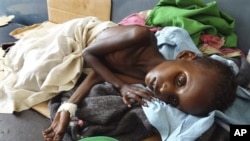



The U.N. refugee agency says it is extremely concerned about the increasingly poor health of recent Somali arrivals in Ethiopia. UNHCR reports it is particularly worried about the many severely malnourished children arriving in the Dollo Ado area near the Somalia/Ethiopia border.
The U.N. refugee agency reports 19 percent of Somali refugee children arriving at the Kobe camp in the Dollo Ado area are suffering from severe acute malnutrition.
UNHCR spokesman Adrian Edwards says at three nearby refugee camps, the rates are 16 percent, 10 percent and seven percent, respectively. “In July, you may recall, we spoke about our concerns of the acute malnutrition in Dollo Ado. Severe acute malnutrition is at a yet more serious level and poses a particular risk for children below the age of five. UNHCR considers a rate of over one percent to be alarming,” Edwards said.
In light of these findings, Edwards says the UNHCR and other aid agencies are planning to increase food distribution points in the camps. He says they also will urgently open more centers for nutritional feeding and make sure that malnourished refugees receive appropriate supplementary food.
“Outreach workers are going to go from tent to tent and look for malnourished children who are not already enrolled in the feeding programs. They will also trace children who may not be continuing with nutritional feeding treatment. Given the severity of the situation, we expect that malnutrition rates will remain high for some weeks until the situation stabilizes,” Edwards said.
Edwards says local Ethiopian authorities in Gode recently told the UNHCR that some people along the Somali-Ethiopian border are actually internally displaced people inside Somalia and not refugees. The refugee-agency spokesman said the border between the two countries is hard to determine, so it is sometimes difficult to clearly establish whether someone is a refugee or simply an internally displaced person.
“If you remember, you become a refugee once you cross an international frontier and if you have a valid claim for asylum. We are endeavoring to help people on both sides. UNHCR does help displaced people too. We have a lot of assistance going to displaced people in other parts of Somalia, as you may know,” Edwards said.
Edwards says a convoy of trucks delivered essential aid items for an estimated 18,500 newly arriving Somalis in the Gode area, 250 kilometers north of Dollo Ado, on Wednesday. Distribution of the relief supplies - shelter material, blankets, sleeping mats and mosquito nets - is to begin shortly.
UN: Somali Famine Refugees' Health Worsens