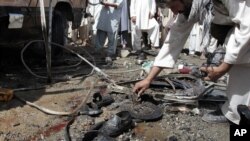
A man collects parts of a damaged bus which was hit by a remote control bomb on the outskirts of Kabul, Afghanistan, August 7, 2012.
A U.N. report says civilian casualties in Afghanistan's conflict declined during the first half of this year, but another study shows Afghans believe their lives have not improved, with many saying they are struggling or suffering.
The United Nations Assistance Mission in Afghanistan, or UNAMA, said Wednesday it documented 3,099 civilian casualties from January to June, a 15-percent drop from the same period in 2011. It said the decline reverses a trend in which civilian casualties had increased steadily in the previous five years.
UNAMA said the total casualties for the first half of 2012 include 1,145 civilians killed and 1,954 others wounded. Despite the decline, it said the level of casualties remains "devastating."
The U.N. report said anti-government forces were responsible for 80 percent of all civilian deaths and injuries, while Afghan government forces and their NATO allies were responsible for 10 percent. U.N. experts could not identify those responsible for the remaining 10 percent of casualties.
UNAMA attributed the decline in civilian casualties partly to a weakening of insurgent networks through military operations by pro-government forces. It said an "unseasonably harsh winter" also may have impeded the movement and operational capacity of insurgents in the first three months of this year.
The U.N. report said improvised explosive devices used by insurgents remain the leading cause of deaths among Afghan women and children. It condemned what it called the "indiscriminate" use of such bombs and demanded that insurgents immediately stop "deliberate" killings of civilians.
The U.N. mission also urged the Afghan government and NATO to increase efforts to ensure that Afghan security forces are "sufficiently trained, resourced, (and) supported" to protect civilians, as NATO troops prepare to leave the country by 2014.
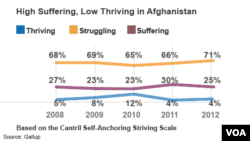
In another report published Wednesday, U.S. polling company Gallup said a recent survey of Afghans found that most people have a pessimistic outlook on life. In face-to-face interviews with 1,000 Afghans aged 15 and older in late April, Gallup found that 71 percent of respondents described themselves as "struggling," a slight increase over last year. It said 25 percent of respondents were classified as suffering, down from 30 percent in 2011.
The survey showed the percentage of Afghans describing themselves as "thriving" was steady at 4 percent.
Gallup said many Afghans are stressed and worried because of ongoing violence by Taliban militants and doubts about their future in a post-NATO Afghanistan.