


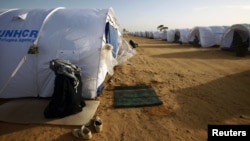
GENEVA — The United Nations High Commissioner for Refugees (UNHCR), Antonio Guterres, says conflict in northern Mali is aggravating the humanitarian crisis in the Sahel and posing a serious threat to regional and global security.
According to a UNHCR report, the conflict in northern Mali has internally displaced more than 200,000 and driven more than a quarter-million refugees into neighboring countries, compounding the situation in West Africa's Sahel region, where some 18 million people are going hungry, more than a million of whom are acutely malnourished children.
While the world community focused on Syria, Guterres says, it ignores the deteriorating situation in Mali at its peril.
"If proper humanitarian assistance is not provided and if a political solution is not found, the risk of this conflict to go far beyond Mali is, in my opinion, enormous, and the implications are very serious for the whole region," he said, explaining that al-Qaida's presence in northern Mali and other countries in the region could also exacerbate crises in Sudan, South Sudan, Somalia, and even Yemen.
"Let us not forget that many of the states of this region are very fragile and have enormous economic, social difficulties, and have a very limited capacity in relation to security," he said, urging international support for ECOWAS-led peace-settlement mediation in Mali.
Calls for Increased Aid to the Sahel
Guterres is also urging international donors to provide more money to U.N. and private aid agencies for humanitarian assistance in the Sahel, saying that current programs are so under-funded that agencies are only able to provide life-saving assistance - namely shelter, food, water and health.
"Very little is being done on education," he said. "Very little is being done on livelihoods and support to the capacity of people to be self-reliant, and very little is being done to support the local communities that are hosting the refugees because there are no funds for that."
The U.N. refugee agency has received about one-third of the $153 million it needs for its Malian refugee operations in Mauritania, Burkina Faso and Niger, and other aid agencies are likewise under-resourced.
The United States, which is the biggest donor, has contributed $350 million for the Sahel emergency, of which more than $30 million goes for Mali. U.S. Assistant Secretary of State for Population, Refugees, and Migration, Anne Richard, who accompanied Guterres return from reviewing the refugee situation in Burkina Faso, says Mali is in the unfortunate situation of having to compete for scarce funds in a year of multiple crises.
"What we are finding is everything is being stretched thin," she said, explaining that more money is needed to help people thrive, not just survive. "And you are all reading about what is happening in Syria on a daily basis, but we're concerned that this particular crisis has been neglected."
According to the U.N. refugee agency officials, while basic life-saving needs for Mali's refugees are guaranteed most cases, currently available funding isn't enough to provide refugees with a dignified quality of life.
Since the democratically elected government of Mali was ousted by a military coup in March, various groups, including Tuareg rebels, Islamists and fighters linked to al-Qaida have been battling for control of the north.