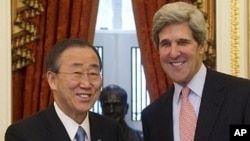



As clashes continue in Ivory Coast, United Nations Secretary-General Ban Ki-moon has again demanded that embattled incumbent president Laurent Gbagbo cease efforts to cling to power. Ban met with members of the Senate Foreign Relations Committee Thursday on Capitol Hill.
The U.N. secretary-general minced no words in his message to Laurent Gbagbo, who the U.N. and most nations say lost the Ivory Coast presidential election to Alassane Ouattara.
"He has to cede his power to a democratically-elected leader, Mr. [Alassane] Ouattara," said Ban. "He has to mind to the well-being and safety and security and prosperity of his people. It is his last opportunity to gracefully exit from this [violent standoff]."
Ban spoke as Gbagbo and Ouattara loyalists continued fighting around the presidential compound in the Ivorian commercial capital, Abidjan. So far, U.N. and French efforts to negotiate an end to the conflict have failed.
The secretary-general said recent U.N. military action in Ivory Coast - including the destruction of heavy weapons used by Gbagbo forces - was necessary.
"We have taken some limited military measures over the last few days in accordance with [the] relevant Security Council resolution to protect the civilian population and in exercising self-defense, because United Nations patrols have been attacked, and United Nations headquarters have been attacked. So we had to take necessary measures," added Ban.
Ban Ki-moon spoke in the Capitol building alongside the chairman of the Senate Foreign Relations Committee, John Kerry of Massachusetts. Nearby, U.S. legislators were engaged in a furious battle over the federal budget one day before a threatened government shutdown.
Kerry said the United States must rectify its fiscal imbalance, but must remain engaged in the world and should not abdicate its foreign responsibilities, including those to the United Nations.
"We all know that the United States is facing a difficult budget moment, and we are all thoughtful about that. But let me emphasize, while some people in the Congress are talking about retrenching and reducing America's presence on a global basis, and particularly reducing America's support for international institutions, I want to firmly state how unwise and even dangerous I believe that kind of move would [be]," said Kerry.
Ban welcomed Senator Kerry's comments, saying that the United Nations is aware of the need for thrift and is attempting to shave its own operating costs.
During their meeting, the secretary-general is reported to have reminded senators of continuing U.N. missions in Afghanistan, Iraq, Sudan, Haiti, and elsewhere.
UN's Ban: Ivory Coast's Gbagbo Must Go