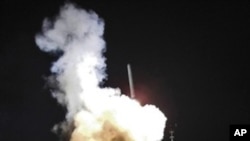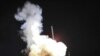



U.S.-led coalition forces have launched more than 100 Tomahawk missiles on key air defense sites across Libya as part of operations to protect the population from the forces of long-time leader Moammar Gadhafi.
U.S. Vice Admiral William Gortney outlined what is being called "Operation Odyssey Dawn" several hours after he said the missiles started hitting more than 20 Libyan sites.
"The United States military has and will continue to use our unique capabilities to create the conditions from which we and our partners can best enforce the full measure of the U.N. mandate. Our mission right now is to shape the battle space in such a way that our partners may take the lead in execution," he said.
He said Admiral Sam Locklear was leading the operations from the USS Mount Whitney in the Mediterranean Sea.
A U.N. Security Council resolution was approved Thursday in New York allowing outside forces to use all measures necessary to protect civilians in Libya, where eastern rebel-controlled areas have been under attack.
Admiral Gortney said one British submarine was used as part of Saturday’s strikes as well as U.S. ships and submarines. He described Libya’s air defense sites as being built with old Soviet technology.
He said some countries who were taking part in the military operation had asked to be identified, while others wanted to announce their involvement themselves.
"Of the coalition, the countries that have asked us to mention their names, of course, the United States, UK, French, Italy and Canada. The other countries have asked for them, that they want to be able to make the announcement and it is the same for the Arab countries as well," he said.
A mediation delegation from the African Union was due in the capital Tripoli Sunday, but as sites in and around Tripoli were also reported hit, it was unclear if that mission would go ahead.
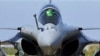
Earlier Saturday, French fighter planes which had departed from France flew over Libya bombing at least one tank that a senior French military official identified as belonging to forces loyal to Mr. Gadhafi.
Leaders from France, Britain and the United States have said the operations are necessary and that Mr. Gadhafi’s forces were still staging attacks despite warnings to stop.
Libya’s head of parliament, Abdul Qasim al-Zuai denied this, saying a ceasefire was in place and that the missile strikes were what he called a "barbaric aggression" from Western powers. He said civilian areas and civilian infrastructure were being targeted.
Earlier in the day, Mr. Gadhafi wrote a letter to President Obama and other world leaders saying they would regret what he called "intervention in the internal affairs of Libya."
Libyan state media said the strikes caused casualties in Tripoli.
At a summit earlier Saturday in Paris, French President Nicolas Sarkozy said Libyans like other Arabs were fighting for democracy and freedom from oppressive regimes and that it was the duty of outside powers to help them.
The British Prime Minister David Cameron said British forces were helping end what he called "the appalling brutality" of Mr. Gadhafi’s government.
Several countries have spoken out against the operations including Russia and Venezuela. Venezuela’s President Hugo Chavez said it was irresponsible to create more deaths and more war.
The International Committee of the Red Cross called on all warring parties to spare civilians and respect international humanitarian law.
The armed rebellion against Mr. Gadhafi began last month, following people power movements which successfully toppled long-time leaders in Egypt and Tunisia and spurred uprisings across north Africa and the Middle East.
US, Allies Attack Libya