



The U.S. Food and Drug Administration, the nation's health regulator, has approved the first artificial retina, an implantable electronic device that can restore limited vision to people blinded by a rare genetic eye disease.
The device, which has been in human clinical trials in the U.S and Europe for several years, offers new hope for people with advanced retinitis pigmentosa, a degenerative condition that damages the light-sensitive layer of cells at the back of the eye known as the retina.
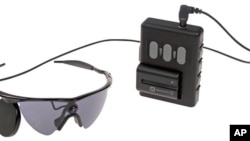
Called Argus II and built by California-based Second Sight Medical Products, Inc., the artificial retina is essentially a sheet of 60 tiny electrodes that surgeons implant directly into the eye. The patient is also fitted with a pair of dark glasses that have a small attached video camera and portable video processor. The battery-operated system sends digitally-generated video signals past the patient's damaged retina, directly to their brain.
The electronic retina does not restore full vision, but allows users to sense light and dark contrasts and to detect movement and important shapes, such as crosswalks in the street, nearby cars or people and some large-type numbers and letters. The images they perceive are in black and white, not color. Eventually, the manufacturer hopes to implant the device not in the eye but in the brain's visual cortex, which could remedy blindness from all causes.
The Argus II was approved in Europe in 2011 to treat a broader group of people, with severe blindness caused by a variety of retinal diseases. Additional clinical trials will be needed in the U.S before the company can seek broader FDA approval.
The device, which has been in human clinical trials in the U.S and Europe for several years, offers new hope for people with advanced retinitis pigmentosa, a degenerative condition that damages the light-sensitive layer of cells at the back of the eye known as the retina.
Called Argus II and built by California-based Second Sight Medical Products, Inc., the artificial retina is essentially a sheet of 60 tiny electrodes that surgeons implant directly into the eye. The patient is also fitted with a pair of dark glasses that have a small attached video camera and portable video processor. The battery-operated system sends digitally-generated video signals past the patient's damaged retina, directly to their brain.
The electronic retina does not restore full vision, but allows users to sense light and dark contrasts and to detect movement and important shapes, such as crosswalks in the street, nearby cars or people and some large-type numbers and letters. The images they perceive are in black and white, not color. Eventually, the manufacturer hopes to implant the device not in the eye but in the brain's visual cortex, which could remedy blindness from all causes.
The Argus II was approved in Europe in 2011 to treat a broader group of people, with severe blindness caused by a variety of retinal diseases. Additional clinical trials will be needed in the U.S before the company can seek broader FDA approval.