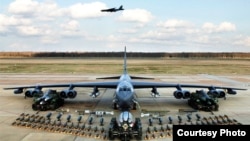
The United States has run its second training mission this month of the nuclear-capable B-52 bomber over the Korean peninsula in a show of military force following North Korea's threats of a nuclear war.
The U.S. Forces Korea says the B-52 Stratofortress practiced dropping bombs on targets at a range in South Korea, Tuesday. It also released several photos of the aircraft, along with the warning that U.S. and South Korean forces are "battle-ready and trained to employ air power to deter aggression" and defend Seoul against any attack.
U.S. officials describe the mission, and an earlier one conducted March 8, as a "routine" part of annual joint military drillswith Seoul. But they have also been explicit that the flights are meant to send a strong message to Pyongyang, which has threatened a preemptive nuclear attack on the U.S. following U.N. sanctions the North's latest nuclear test.
On Monday, Pentagon spokesperson George Little on Monday said the flights send a "very strong signal" the U.S. is firmly committed to its alliance with Seoul. He says the United States is "drawing attention to the fact we have extended deterrence capabilities that we believe are important in the wake of recent North Korean rhetoric."
Carl Baker, with the Hawaii-based Pacific Forum think-tank, says he is certain the North Koreans are paying attention to the drills and are "very familiar" with what the B-52 flyovers represent.
"The United States is trying to send a very strong signal to North Korea that it is not going to bend; that it is not going to go back to negotiations just because North Korea has expressed commitment to using nuclear weapons," said Baker.
But, although North Korea appears to be getting the message, it has not shown signs of backing down. A foreign ministry spokesperson in the North promised Wednesday a "strong military counteraction" if the U.S. continues the B-52 flyovers. In comments carried in the official Korean Central News Agency, he calls the flights an "unpardonable provocation" and says the situation is "inching close to the brink of war."
Leonid Petrov, a Korea researcher at the Australian National University, says he expects more of that kind of talk from North Korea, as a result of the B-52 missions and corresponding war drills. He thinks the exercises are further destabilizing the situation, leaving Pyongyang with little choice but to continue developing nuclear weapons to survive.
"I think it's pretty understandable that the people of Korea are quite indignant at the resumption of this flight and the regular U.S.-South Korean military drills," said Petrov. "We know that strategic bombers have been used by the U.S. military in the North Pacific to scare North Korea."
Daniel Pinkston, an analyst for the International Crisis Group, says he is not sure whether the projection of American military power will be successful in reducing tensions on the peninsula. But, he says demonstrating U.S. military superiority will likely succeed in deterring North Korea from carrying out a nuclear attack.
"In the past, when [the North Koreans] have embarked upon military adventurism, it has been at times when the opposing forces are off-guard or when the North Koreans view them as being weak," said Pinkston. "So, I think these types of exercises and training sends a very clear signal that deters and greatly reduces the likelihood of North Korea lashing out in violent ways as they have done on numerous occasions in the past century."
Pinkston says North Korea - which operates with the songun, or military first, ideology - is "very very cognizant" of the military balance between it and Washington.
"When they know they will take a severe beating, then they will behave. But, when you are weak, they won't behave - then they will use violence and force to push their agenda," he added.
The U.S.-South Korean military drills, known as Foal Eagle, began March 1 and are scheduled to last until the end of April. A separate, computer-simulated round of drills, known as Key Resolve, began on March 11 and last through Thursday.
North Korea had threatened military action if the United States continues with the computer-based drills. Washington has disregarded the threat and proceeded as normal. Although Pyongyang claims to have scrapped the 60-year armistice deal that ended the Korean War, it is yet to follow through on its threats of violence.
The U.S. Forces Korea says the B-52 Stratofortress practiced dropping bombs on targets at a range in South Korea, Tuesday. It also released several photos of the aircraft, along with the warning that U.S. and South Korean forces are "battle-ready and trained to employ air power to deter aggression" and defend Seoul against any attack.
U.S. officials describe the mission, and an earlier one conducted March 8, as a "routine" part of annual joint military drillswith Seoul. But they have also been explicit that the flights are meant to send a strong message to Pyongyang, which has threatened a preemptive nuclear attack on the U.S. following U.N. sanctions the North's latest nuclear test.
On Monday, Pentagon spokesperson George Little on Monday said the flights send a "very strong signal" the U.S. is firmly committed to its alliance with Seoul. He says the United States is "drawing attention to the fact we have extended deterrence capabilities that we believe are important in the wake of recent North Korean rhetoric."
Carl Baker, with the Hawaii-based Pacific Forum think-tank, says he is certain the North Koreans are paying attention to the drills and are "very familiar" with what the B-52 flyovers represent.
"The United States is trying to send a very strong signal to North Korea that it is not going to bend; that it is not going to go back to negotiations just because North Korea has expressed commitment to using nuclear weapons," said Baker.
But, although North Korea appears to be getting the message, it has not shown signs of backing down. A foreign ministry spokesperson in the North promised Wednesday a "strong military counteraction" if the U.S. continues the B-52 flyovers. In comments carried in the official Korean Central News Agency, he calls the flights an "unpardonable provocation" and says the situation is "inching close to the brink of war."
Leonid Petrov, a Korea researcher at the Australian National University, says he expects more of that kind of talk from North Korea, as a result of the B-52 missions and corresponding war drills. He thinks the exercises are further destabilizing the situation, leaving Pyongyang with little choice but to continue developing nuclear weapons to survive.
"I think it's pretty understandable that the people of Korea are quite indignant at the resumption of this flight and the regular U.S.-South Korean military drills," said Petrov. "We know that strategic bombers have been used by the U.S. military in the North Pacific to scare North Korea."
Daniel Pinkston, an analyst for the International Crisis Group, says he is not sure whether the projection of American military power will be successful in reducing tensions on the peninsula. But, he says demonstrating U.S. military superiority will likely succeed in deterring North Korea from carrying out a nuclear attack.
"In the past, when [the North Koreans] have embarked upon military adventurism, it has been at times when the opposing forces are off-guard or when the North Koreans view them as being weak," said Pinkston. "So, I think these types of exercises and training sends a very clear signal that deters and greatly reduces the likelihood of North Korea lashing out in violent ways as they have done on numerous occasions in the past century."
Pinkston says North Korea - which operates with the songun, or military first, ideology - is "very very cognizant" of the military balance between it and Washington.
"When they know they will take a severe beating, then they will behave. But, when you are weak, they won't behave - then they will use violence and force to push their agenda," he added.
The U.S.-South Korean military drills, known as Foal Eagle, began March 1 and are scheduled to last until the end of April. A separate, computer-simulated round of drills, known as Key Resolve, began on March 11 and last through Thursday.
North Korea had threatened military action if the United States continues with the computer-based drills. Washington has disregarded the threat and proceeded as normal. Although Pyongyang claims to have scrapped the 60-year armistice deal that ended the Korean War, it is yet to follow through on its threats of violence.