


WASHINGTON —
The U.S. has 50 states, but its national presidential election is likely to be decided in about a quarter of them.
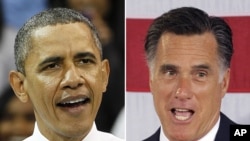
They are often called battleground states, where surveys show that voters are closely split in deciding whether to give the Democratic incumbent, President Barack Obama, a second four-year term in the White House, or come January, make his Republican challenger, one-time venture capitalist Mitt Romney, the American leader. They are the states that sometimes swing from election to election in their support for Democratic or Republican candidates, whether for president or lawmakers in Congress.

Voters across the country are now weighing their choice in advance of the November 6 election, with residents in some states already starting to cast ballots under early-voting provisions. But analysts watching the close contest say the presidential outcome is likely to be decided in 12 or 13 of the states.
U.S. presidents are essentially elected in a collection of state-by-state contests, in a two-century-old electoral college system, with each state’s influence on the outcome roughly dependent on the size of its population.
Political scientist Stephen Wayne at Georgetown University in Washington said the candidates pick the places where they campaign because they think they have a chance of winning another state in their quest to reach the needed majority of 270 votes in the electoral college.
“The candidates do a really good job of monitoring which states they have a chance at," Wayne said. "And then they follow the polls, since the polls show that they’re winning by a lot, or losing by a lot, they’ll move out of that state. If you know how the state’s going to turn out, then you don’t concentrate in those states, you concentrate in other states where you’re not sure and you think your campaign will make a difference, one way or another.”
Key States
So it is that Obama and Romney, and their respective running mates, Vice President Joe Biden and Wisconsin congressman Paul Ryan, are regularly staging rallies in the industrial heartland of the country, in the states of Ohio, Michigan, Pennsylvania and Wisconsin. They are wooing farmers in the rural Midwestern state of Iowa, visiting retirees in warm-weather Florida in the southeast and looking for votes among government workers in the Virginia suburbs outside the national capital, Washington.
The presidential contenders are also stopping in the small rural state of New Hampshire in the northeastern sector of the country, the technology and financial centers in the mid-Atlantic state of North Carolina, and the central state of Missouri. They also head regularly to three western states - the gambling mecca of Nevada, mountainous Colorado and New Mexico, the mostly rural sagebrush state on the country’s southwestern border with Mexico.
One recent survey of the battleground states, by the respected Gallup poll, showed that voters in the battleground states narrowly favored Obama, by a 48-to-46 percent margin. Other surveys generally show the president holding slight leads over Romney in all but two of the battleground states - Missouri and North Carolina. Obama has moved marginally ahead in several national surveys as well, or, at worst, is tied with Romney.
With the election being waged in the battleground states, the candidates only fleetingly visit some of the country’s most populous states - New York, California, Illinois and Texas - and then just long enough to tap the pockets of some of their wealthiest supporters for campaign donations. The reason is simple: Voter surveys show that Obama is handily ahead in liberal-oriented New York, California and his home state of Illinois, while Romney is expected to easily carry the conservative southern state of Texas.
The U.S. - unlike many democracies throughout the world -- does not elect its leader through a direct popular vote, as is the case with French presidential elections. And it does not have a prime minister, as is the case in parliamentary systems throughout Europe and some other parts of the world, where the country’s leader is picked from among the lawmakers whose party wins the most seats in parliament.
Since U.S. states vary widely in population, they also have vastly different numbers of electoral votes - and as a result a sharply contrasting influence on the eventual outcome of the election.
California, the most populous state, has 55 electoral votes, while several sparsely populated states have only three. So in the final six weeks of the campaign, the two presidential contenders and their running mates are doing almost all of their campaigning in the eastern half of the country, where 10 of the battleground states are located and the outcome is uncertain.
With a couple of exceptions, the popular vote winner in each state collects all of the electoral votes from that state. The national popular vote does not determine the winner.
Electoral College History
Political scientist Wayne said the U.S. electoral college has its roots in the country’s founding days more than two centuries ago.
“The electoral college system was created by the framers of the American constitution to try to make sure that the most qualified person, not necessarily the most popular, would be elected president," Wayne said. "And the framers of the American constitution in 1787, 1788, when it was written, did not have a lot of faith in the knowledge and the abilities of average citizens to make an intelligent choice. And most people weren’t educated at that point. Illiteracy was very high.”
As a result, he said the country’s earlier leaders settled on creation of its electoral college.
“So they designed a system whereby states would choose people - presumably these people would be better educated - and those people would then choose the president based more on ability than popularity," Wayne said.
Use of the electoral college has on three occasions resulted in a president assuming office who did not win the most votes nationally, but carried states with the most electoral votes. That occurred most recently in 2000, when Republican George W. Bush won the first of his two terms as president.
The political battleground states develop over time, partly because of changing demographics. Wayne says the less politically competitive states are often identified by voters’ political allegiances and ideological views.
“Much of it has to do with partisanship, and where Republicans and Democrats live," the political scientist explained. "There are certain states where there are more Republicans than Democrats, and vice versa. It also has to do with ideological beliefs that people in the South tend to be more conservative than the people in the northeast and up [along] the Pacific Coast. And so you tend to have states that are not as closely balanced politically.”
Obama leading
He said that at least for the moment, Obama enjoys the edge in the race, even though the American economy is only sluggishly recovering from the severe downturn in 2008 and 2009, and many voters blame him for the slow advance.
“Incumbents do have an advantage over challengers," Wayne said of U.S. elections. "Americans prefer the devil they know to the devil they don’t know. There are signs that the economy is not getting weaker. People seem to be a little bit more confident now, or maybe a little less fearful. And the anger against Obama has dissipated a little bit. People are disappointed in his presidency, but with the exception of Republicans, they’re not angry.”
Wayne said that Romney, a former governor of Massachusetts, has yet to convince enough voters that he should replace the president.
"Romney’s got to prove that he is the equal of the president," Wayne concluded. "We don’t change horses until either we are very dissatisfied or somebody makes an acceptable case for change. Romney hasn’t made that case yet. And while people are dissatisfied, they’re not very dissatisfied.”
They are often called battleground states, where surveys show that voters are closely split in deciding whether to give the Democratic incumbent, President Barack Obama, a second four-year term in the White House, or come January, make his Republican challenger, one-time venture capitalist Mitt Romney, the American leader. They are the states that sometimes swing from election to election in their support for Democratic or Republican candidates, whether for president or lawmakers in Congress.
Voters across the country are now weighing their choice in advance of the November 6 election, with residents in some states already starting to cast ballots under early-voting provisions. But analysts watching the close contest say the presidential outcome is likely to be decided in 12 or 13 of the states.
U.S. presidents are essentially elected in a collection of state-by-state contests, in a two-century-old electoral college system, with each state’s influence on the outcome roughly dependent on the size of its population.
Political scientist Stephen Wayne at Georgetown University in Washington said the candidates pick the places where they campaign because they think they have a chance of winning another state in their quest to reach the needed majority of 270 votes in the electoral college.
“The candidates do a really good job of monitoring which states they have a chance at," Wayne said. "And then they follow the polls, since the polls show that they’re winning by a lot, or losing by a lot, they’ll move out of that state. If you know how the state’s going to turn out, then you don’t concentrate in those states, you concentrate in other states where you’re not sure and you think your campaign will make a difference, one way or another.”
Key States
So it is that Obama and Romney, and their respective running mates, Vice President Joe Biden and Wisconsin congressman Paul Ryan, are regularly staging rallies in the industrial heartland of the country, in the states of Ohio, Michigan, Pennsylvania and Wisconsin. They are wooing farmers in the rural Midwestern state of Iowa, visiting retirees in warm-weather Florida in the southeast and looking for votes among government workers in the Virginia suburbs outside the national capital, Washington.
The presidential contenders are also stopping in the small rural state of New Hampshire in the northeastern sector of the country, the technology and financial centers in the mid-Atlantic state of North Carolina, and the central state of Missouri. They also head regularly to three western states - the gambling mecca of Nevada, mountainous Colorado and New Mexico, the mostly rural sagebrush state on the country’s southwestern border with Mexico.
One recent survey of the battleground states, by the respected Gallup poll, showed that voters in the battleground states narrowly favored Obama, by a 48-to-46 percent margin. Other surveys generally show the president holding slight leads over Romney in all but two of the battleground states - Missouri and North Carolina. Obama has moved marginally ahead in several national surveys as well, or, at worst, is tied with Romney.
With the election being waged in the battleground states, the candidates only fleetingly visit some of the country’s most populous states - New York, California, Illinois and Texas - and then just long enough to tap the pockets of some of their wealthiest supporters for campaign donations. The reason is simple: Voter surveys show that Obama is handily ahead in liberal-oriented New York, California and his home state of Illinois, while Romney is expected to easily carry the conservative southern state of Texas.
The U.S. - unlike many democracies throughout the world -- does not elect its leader through a direct popular vote, as is the case with French presidential elections. And it does not have a prime minister, as is the case in parliamentary systems throughout Europe and some other parts of the world, where the country’s leader is picked from among the lawmakers whose party wins the most seats in parliament.
Since U.S. states vary widely in population, they also have vastly different numbers of electoral votes - and as a result a sharply contrasting influence on the eventual outcome of the election.
California, the most populous state, has 55 electoral votes, while several sparsely populated states have only three. So in the final six weeks of the campaign, the two presidential contenders and their running mates are doing almost all of their campaigning in the eastern half of the country, where 10 of the battleground states are located and the outcome is uncertain.
With a couple of exceptions, the popular vote winner in each state collects all of the electoral votes from that state. The national popular vote does not determine the winner.
Electoral College History
Political scientist Wayne said the U.S. electoral college has its roots in the country’s founding days more than two centuries ago.
“The electoral college system was created by the framers of the American constitution to try to make sure that the most qualified person, not necessarily the most popular, would be elected president," Wayne said. "And the framers of the American constitution in 1787, 1788, when it was written, did not have a lot of faith in the knowledge and the abilities of average citizens to make an intelligent choice. And most people weren’t educated at that point. Illiteracy was very high.”
As a result, he said the country’s earlier leaders settled on creation of its electoral college.
“So they designed a system whereby states would choose people - presumably these people would be better educated - and those people would then choose the president based more on ability than popularity," Wayne said.
Use of the electoral college has on three occasions resulted in a president assuming office who did not win the most votes nationally, but carried states with the most electoral votes. That occurred most recently in 2000, when Republican George W. Bush won the first of his two terms as president.
The political battleground states develop over time, partly because of changing demographics. Wayne says the less politically competitive states are often identified by voters’ political allegiances and ideological views.
“Much of it has to do with partisanship, and where Republicans and Democrats live," the political scientist explained. "There are certain states where there are more Republicans than Democrats, and vice versa. It also has to do with ideological beliefs that people in the South tend to be more conservative than the people in the northeast and up [along] the Pacific Coast. And so you tend to have states that are not as closely balanced politically.”
Obama leading
He said that at least for the moment, Obama enjoys the edge in the race, even though the American economy is only sluggishly recovering from the severe downturn in 2008 and 2009, and many voters blame him for the slow advance.
“Incumbents do have an advantage over challengers," Wayne said of U.S. elections. "Americans prefer the devil they know to the devil they don’t know. There are signs that the economy is not getting weaker. People seem to be a little bit more confident now, or maybe a little less fearful. And the anger against Obama has dissipated a little bit. People are disappointed in his presidency, but with the exception of Republicans, they’re not angry.”
Wayne said that Romney, a former governor of Massachusetts, has yet to convince enough voters that he should replace the president.
"Romney’s got to prove that he is the equal of the president," Wayne concluded. "We don’t change horses until either we are very dissatisfied or somebody makes an acceptable case for change. Romney hasn’t made that case yet. And while people are dissatisfied, they’re not very dissatisfied.”