


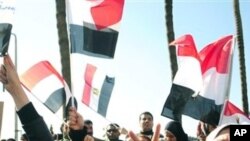
The United States says the Egyptian government must do more to address the demands of opposition groups. It is calling for Cairo to immediately repeal an emergency law allowing detention without charge, and to allow greater participation in transition talks.
The White House says Vice President Joe Biden spoke to his counterpart in Egypt Tuesday to emphasize that the Egyptian government must stop beating, harassing and detaining protesters and those reporting on the massive demonstrations.
Biden also told Omar Suleiman that Egypt should broaden the range of opposition groups included in developing a plan for transitioning the government, and immediately rescind the country's deeply unpopular emergency law, in place since Mr. Mubarak took office in 1981.
In New York Tuesday, U.N. chief Ban Ki-moon said the Egyptian people are frustrated and demanding "bold reforms" that should be implemented quickly - "the sooner the better." He said all parties must avoid violence and he repeated his call for an "orderly and peaceful transition."
Mr. Ban said Egypt and its president, Hosni Mubarak, are key players in the Middle East peace process, and that he hoped Cairo will continue to play an important stabilizing role in a volatile region.
Earlier, in his first public comments on the unrest, U.S. Defense Secretary Robert Gates praised the Egyptian military for its restraint, reiterated the need for an orderly and steady transition, and prodded other Arab governments in the region to reform.
Gates said the pro-democracy demonstrations in Egypt and Tunisia should inspire other Middle Eastern governments to begin moving in a "positive direction" toward addressing the political and economic grievances of their people.
U.S. President Barack Obama has called for a transition in Egypt that engages all parties and leads to democratic practices, free and fair elections, and a representative government that is responsive to the grievances of the people.
U.S. government figures indicate the State Department and U.S. Agency for International Development (USAID) provided $1.5 billion in assistance to Egypt last year, mostly for security. The budget request for 2011 is about the same. U.S. officials say there are no plans to cut off the aid, but caution the assistance will be reviewed as events unfold.
Mr. Mubarak, who has been president for nearly three decades, has responded to the protests by declaring that he will not run for a sixth term in a September election.