


Concerns about the climate-changing effects of carbon dioxide, or CO2, emissions in the United States have focused attention not just on big industrial polluters and automobile exhaust, but also on agriculture.
Farming and ranching contribute six percent of the country’s annual CO2 emissions. Beef production accounts for a third of that, which is roughly equal to the exhaust from 24 million cars. To lower these emissions, many American cattle farmers are adopting an environmentally-friendly ranching system first developed in Africa more than 40 years ago.
Holistic herding
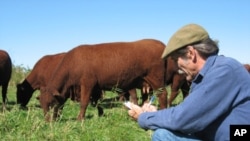
Massachusetts beef farmer Ridge Shinn is using a time-tested agricultural model known as holistic herding, which he says helps cut his farm’s carbon emissions by putting CO2 back where it came from; in the soil.
"What we’ve discovered is that you actually sequester huge amounts of carbon by grazing correctly," says Shinn.
Holistic herding was developed in the 1970s by Allan Savory, a biologist and game warden-turned-rancher in what is now Zimbabwe. While observing herd animals, such as buffalo, deer, and antelope, Savory noticed how they naturally move to new grazing areas daily, unlike domesticated animals, which are typically penned in the same pasture for months at a time.
As a result, the domestic herds denude the land of CO2-absorbing plants and churn up the ground with their hooves, releasing soil-sequestered carbon in the process.
Shinn says he’s preventing that kind overgrazing by employing Savory’s holistic herding system on a section of pasture.
"What we do instead is we take that same 50 animals and put them on a very small part of that 50 acres for one day. And then, the next day, we move them off that one acre. So, that acre is now resting and by the time we get around the whole 50 acres, you know, putting them on an acre a day, 50 days have passed and this piece of ground has had a chance to rest and reinvigorate."
Building on nature
Holistic herding builds on nature’s carbon cycle. Soil needs carbon to help create the rich nutrients essential for healthy plant life. When herd animals roam through an area, they graze down the vegetation. Their hooves act as tillers for dead and decomposing plants. Their manure and methane waste act as fertilizers to help grow more vegetation. Pasture plants such as clover and grasses help to remove carbon dioxide from the atmosphere and store it in the soil. And so the cycle continues.
Philip Metzger, with the US Department of Agriculture’s Natural Resources Conservation Service, says holistic herding can prevent the serious reductions in farm output caused by overgrazing.
"You can see it in agriculture today as we’re having to put more and more inputs into the soil to get the same yields," says Metzger. "That’s because we have reduced organic matter, in many cases by 50 percent, so that soil now has much less holding capacity for water and nutrients."
Speeding regeneration
Metzger says holistic herding can also speed the regeneration of badly overgrazed soils in just three to four years, compared to the decades it can take if the land is simply left fallow.
The results with holistic herding have been so positive over the years that developer Allan Savory was awarded the 2010 Buckminster Fuller Challenge Award, a privately-sponsored $100,000 prize to honor strategies that help to solve humanity’s most pressing problems. The award cited Savory’s Operation Hope, a program that trains African communities to practice holistic herding. The method has also proved popular with ranchers in Australia, New Zealand, and with agricultural extension services across the United States.
U.S. ranchers like Shinn are passionate advocates of the system. "It’s amazing. It’s so optimistic that you can change a whole biological system that quickly by applying the herbivores correctly. It’s a complex story but it’s very exciting."
In addition to reducing CO2 emissions, holistic herding also requires less land because cattle are kept together in a series of adjacent fenced paddocks, instead of being left to roam over large, unmanageable areas. And sheep, goats and other large livestock can also be grazed this way.
The U.S. Department of Agriculture hopes new federal farm legislation due next year will include incentives for U.S. ranchers to adopt holistic herding practices, encouraging them not only to reduce overgrazing but also to shrink agriculture’s big carbon footprint.