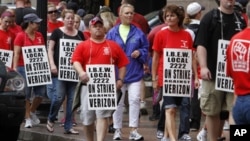
Relations between workers and employers have been contentious in the United States this year, sparking protests by thousands of employees, partisan wrangling in Congress, and vows by key labor and business organizations to push harder for their respective political and economic goals.
Protestors chanted and drummed in the capitol of in the north central state of Wisconsin earlier this year.
Related video report by Mil Arcega
Tens of thousands of public employees and their supporters protestested Governor Scott Walker's efforts to strip government workers of their ability to bargain for wages and benefits through unions. The political debate pitted Walker and other Republicans against unions and Democrats, and went on for months.
Wisconsin is only one dispute this Labor Day as business and workers haggle over jobs, wages, benefits and political power.
It is a debate about the proper balance between the needs of business to make a profit and the needs of workers to make a good living. Without profit, businesses cannot survive. And without adequate wages, workers cannot do the consumer spending that drives most U.S. economic activity.
Unions once represented more than one-third of U.S. workers, but decades of declining membership mean they now speak for only 12 percent. While overall union membership is down, membership remains strong among people who work for the federal, local, and state governments. Public sector employees are more than half of the more than 14 million union members in the United States.
Wages, benefits and job security of these workers have been the target of efforts to cut costs at a time when a faltering economy has hurt tax revenue and created serious financial problems for governments.
Economist Gary Burtless of the Washington-based Brookings Institution says public sector unions have been hurt by nearly one million layoffs and the situation is growing more difficult.
"Over the last year, there has been a remarkably rapid deterioration in the bargaining power of labor unions and of workers in general who work for public sector employers," Burtless said.
Burtless says workers' salaries have not kept up with gains in productivity and that workers are getting less of a share of the value that is produced by companies, while owners and top managers are getting bigger rewards.
The head of the nation's largest labor union group, Richard Trumka of the AFL-CIO, vows to step up efforts to recruit, organize and mobilize union members. He says the political actions in Wisconsin are part of a concerted and unprecedented Republican attack on public sector workers at all levels of government.
"What is at stake is the future of the country and whether you have a country that continues to bifurcate, where you have rich and poor but no middle class, where there is fewer rich and more poor, and the poor keep growing. That is what is at stake here -- the direction of the country," Trumka said.
Trumka says organized labor will continue supporting political candidates who are sympathetic to labor causes, and do more to boost labor's political agenda and reach out to non-union workers.
The union campaign is being resisted by the U.S. Chamber of Commerce, the nation's largest business association. The head of the group, Thomas Donahue, says unions have too much political power, and too much influence over the Democratic Party and the Obama administration.
Donahue says businesses could do more to boost the economy and create jobs, if Washington would stop imposing new regulations on companies, particularly regarding environmental and labor issues.
"Now is not the time for a slew of new regulations that kill jobs, now is the time to create jobs," Donahue said.
Although that dispute will likely go on for some time, a new set of labor-management negotiations are beginning in the U.S. auto industry.
The industry has recovered after Washington used emergency loans to rescue two of the three large U.S. car makers, and unions made concessions on wages and benefits.
Now the companies are making profits and the United Auto Workers union is looking for a way to improve the salaries and benefits of their lowest-paid members.
US Companies, Labor Unions Struggle Over Politics Profits, Wages