



PHNOM PENH — The United States says military and diplomatic defections in Syria show a continuing "momentum building" against President Bashar al-Assad. The White House said Thursday that desperation is growing within Assad's government. Secretary of State Hillary Clinton is calling for tougher U.N. action against Damascus.
The U.S. comments come after Syria's ambassador to Iraq defected and joined the opposition. Nawaf Fares urged members of Syria's military to join him, because, he said, there is no honor in killing one's own people.
Fares is the highest-ranking Syrian official to switch sides since the uprising against Assad began 16 months ago and is one of five prominent defectors.
Secretary Clinton says the defections show pressure is mounting on President Assad to give up power.
"The economy is in shambles," said Clinton. "The regime is struggling to hold on to large parts of the country. So we do look to the Security Council and all of its members, including Russia, to join us in a serious resolution that gives special envoy Kofi Annan what he needs."
Clinton spoke with Annan following his meetings this week in Damascus, Tehran, and Baghdad and says she is encouraged that the U.N. and Arab League envoy is asking for a U.N. resolution that both endorses political transition and has real consequences for those who do not comply.
"The United States is determined to support him [Annan] because our experience of the last year makes it absolutely clear that the Assad regime will not do anything without additional further pressure," Clinton added.
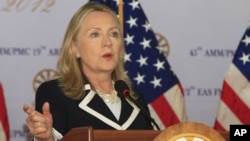
Clinton spoke with reporters in Cambodia where she met with Chinese Foreign Minister Yang Jiechi on the sidelines of a meeting of the Association of Southeast Asian Nations.
Russia and China have previously vetoed tougher U.N. action against Damascus on the grounds that it could lead to military intervention. Russia vowed Thursday to continue that stance.
But Clinton says the United States and China agreed to do everything they can to back a political transition that is endorsed by all five permanent members of the Security Council and includes real consequences for President Assad for, in her words, continuing to defy his obligations to his own people and to the international community.
"And we call on the Syrian military and business community to choose a democratic future rather than to cling to this crumbling regime," Clinton added.
U.S. officials say the resolution being drafted would unify international economic sanctions against Syria if President Assad does not agree to a political transition.
The U.S. comments come after Syria's ambassador to Iraq defected and joined the opposition. Nawaf Fares urged members of Syria's military to join him, because, he said, there is no honor in killing one's own people.
Fares is the highest-ranking Syrian official to switch sides since the uprising against Assad began 16 months ago and is one of five prominent defectors.
Secretary Clinton says the defections show pressure is mounting on President Assad to give up power.
"The economy is in shambles," said Clinton. "The regime is struggling to hold on to large parts of the country. So we do look to the Security Council and all of its members, including Russia, to join us in a serious resolution that gives special envoy Kofi Annan what he needs."
Clinton spoke with Annan following his meetings this week in Damascus, Tehran, and Baghdad and says she is encouraged that the U.N. and Arab League envoy is asking for a U.N. resolution that both endorses political transition and has real consequences for those who do not comply.
"The United States is determined to support him [Annan] because our experience of the last year makes it absolutely clear that the Assad regime will not do anything without additional further pressure," Clinton added.
Clinton spoke with reporters in Cambodia where she met with Chinese Foreign Minister Yang Jiechi on the sidelines of a meeting of the Association of Southeast Asian Nations.
Russia and China have previously vetoed tougher U.N. action against Damascus on the grounds that it could lead to military intervention. Russia vowed Thursday to continue that stance.
But Clinton says the United States and China agreed to do everything they can to back a political transition that is endorsed by all five permanent members of the Security Council and includes real consequences for President Assad for, in her words, continuing to defy his obligations to his own people and to the international community.
"And we call on the Syrian military and business community to choose a democratic future rather than to cling to this crumbling regime," Clinton added.
U.S. officials say the resolution being drafted would unify international economic sanctions against Syria if President Assad does not agree to a political transition.