


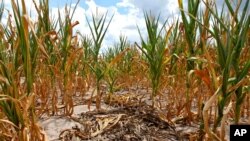
Maize and soybean prices set new records as drought continues to spread across the American Midwest. Higher food prices are expected to follow, and the U.S. meat industry will be especially hard hit.
Maize traded above $8 a bushel (per 25 kilograms) in futures trading Thursday. That breaks a record set last July. It is about four times the average maize price through most of the 2000's.
Soybeans used to trade at around $5 a bushel, says Purdue University economist Chris Hurt. "Now we're trading at over $17," he said. "So again, tripling a base price just a few years ago."
Hurt says the U.S. drought hits at a time when supplies are already extremely tight. About a quarter of the U.S. maize crop is made into ethanol fuel, and China's growing appetite for livestock feed is gobbling up soybeans.
Higher prices will help farmers who have a crop to sell. But with three-quarters of the crop in drought-hit areas, many farmers will be taking losses. And Hurt notes that crop farmers will not be the only ones who suffer.
"The animal sector is also going to have major financial losses," said Hurt. "They have much higher feed costs. And in the short run they can't pass that on to consumers."
Hurt says there may even be bankruptcies in the U.S. livestock industry.
And since American farmers are the largest suppliers of food commodities to the world, Hurt sees a global impact.
"So, this shortage in the United States is clearly going to cause concerns and problems in the rest of the world," he said.
He says the drought will push up prices for bread, cereal and other grain-based foods first. "The people that hurts the very most always in these situations is the lowest-income people in the world, those who are already in dire poverty."
The poor in sub-Saharan Africa likely will not be hit as hard as in other food price spikes over the past five years, according to Maximo Torero with the International Food Policy Research Institute. Torero says that's because those countries mostly grow their own maize. But impacts will be bigger in other regions.
"What it will do is it will affect of course the price of meat and dairy in the following months. And that sure will affect Asia, especially China and India," said Torero.
Experts say the effects will likely grow as the drought in the United States continues.
Maize traded above $8 a bushel (per 25 kilograms) in futures trading Thursday. That breaks a record set last July. It is about four times the average maize price through most of the 2000's.
Soybeans used to trade at around $5 a bushel, says Purdue University economist Chris Hurt. "Now we're trading at over $17," he said. "So again, tripling a base price just a few years ago."
Hurt says the U.S. drought hits at a time when supplies are already extremely tight. About a quarter of the U.S. maize crop is made into ethanol fuel, and China's growing appetite for livestock feed is gobbling up soybeans.
Higher prices will help farmers who have a crop to sell. But with three-quarters of the crop in drought-hit areas, many farmers will be taking losses. And Hurt notes that crop farmers will not be the only ones who suffer.
"The animal sector is also going to have major financial losses," said Hurt. "They have much higher feed costs. And in the short run they can't pass that on to consumers."
Hurt says there may even be bankruptcies in the U.S. livestock industry.
And since American farmers are the largest suppliers of food commodities to the world, Hurt sees a global impact.
"So, this shortage in the United States is clearly going to cause concerns and problems in the rest of the world," he said.
He says the drought will push up prices for bread, cereal and other grain-based foods first. "The people that hurts the very most always in these situations is the lowest-income people in the world, those who are already in dire poverty."
The poor in sub-Saharan Africa likely will not be hit as hard as in other food price spikes over the past five years, according to Maximo Torero with the International Food Policy Research Institute. Torero says that's because those countries mostly grow their own maize. But impacts will be bigger in other regions.
"What it will do is it will affect of course the price of meat and dairy in the following months. And that sure will affect Asia, especially China and India," said Torero.
Experts say the effects will likely grow as the drought in the United States continues.