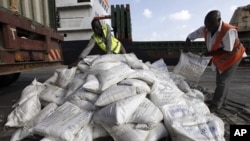
The United States has told aid organizations that they will not face prosecution based on U.S. sanction laws for sending assistance into famine-stricken areas of Somalia controlled by al-Shabab, the al-Qaida-linked organization. Officials say the number one priority is to save lives as famine ravages the region.
What senior administration officials called new guidance, later commented on by spokesmen at the State Department and White House, is aimed at removing hesitations aid groups may have had about moving assistance into areas controlled by al-Shabab.
Briefing reporters in a telephone news conference, the officials said the action was aimed at improving aid flows particularly to southern Somalia where about two million to three million people are in need.
The United Nations has said about 12 million people are in urgent need of assistance not only in Somalia, but in Ethiopia and Kenya as famine expands in the region due to drought.
State Department spokesman Mark Toner said the decision was made because of the scope of the humanitarian crisis.
"To send a strong message publicly to these [aid] groups that are working in the region that it is okay for them to bring this kind of humanitarian assistance into areas that are controlled by al-Shabab, they won't be held accountable to U.S. laws that previously constrained them, and also to ease some of the licensing requirements on them," he said.
Under the change, the State Department and U.S. Agency for International Development (USAID) have been authorized to provide grants and contracts to fund operations by non-government organizations moving aid into areas under de facto control of al-Shabab.
The decision effectively immunizes aid groups, including those responding to a $1.4 billion United Nations appeal for the region, so they are not as one senior administration put it, "in conflict with U.S. laws or regulations that seek to limit resources flowing to al-Shabab."
"Because al-Shabab controls so much of the territory, allowing for this flexibility gives the assurance to these aid workers that they can get that aid to the people who need it and not worry that they are operating in conflict with U.S. laws and obligations," White House spokesman Jay Carney said.
The State Department declared al-Shabab a terrorist organization in 2008, and U.S. sanctions make it a crime to provide any support to it. Officials put U.S. aid to Somalia, which had decreased, at $80 million, part of a $459 million package to reach 4.6 million people throughout the Horn of Africa.
In their background briefing, senior administration officials noted that al-Shabab has sent mixed signals regarding outside aid. But they said the organization is not "monolithic", which may present opportunities for humanitarian aid to get into the south.
The officials said the most important issues for aid groups are safety and security, but noted that some aid has been delivered. They referred to taxes, tolls and other restrictions on the ground as key obstacles to providing assistance.
The United States continues to be concerned about al-Shabab profiting from aid that might fall into its hands, but the senior officials said there is a need to, "continue to thread this needle" to help people in need.
US Eases Sanctions on Al-Shabab to Improve Famine Aid Access
- By Dan Robinson