News / USA

Central Bank Says US Economy 'Paused'

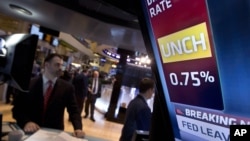
A television screen in a post on the floor of the New York Stock Exchange shows the decision of the Federal Reserve, January 30, 2013.
TEXT SIZE - +
VOA News
Top officials of the U.S. central bank say the economy "paused" in recent months.

That is why the Federal Reserve decided to continue an effort to stimulate the economy.  That program involves buying $85 billion worth of bonds a month, and is intended to cut long-term interest rates.  The bank is also keeping short term interest rates at the record-low levels where they have been for some time.

The fed action came the same day a study showed the U.S. economy shrank slightly in the last three months of 2012.  Government experts blamed the slowdown on cuts in government spending, slowing exports, and businesses keeping smaller inventories.

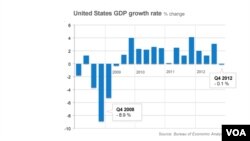
Wednesday's report from the Commerce Department says the economy shrank at a one-tenth of one percent annual rate in the fourth quarter.  That is the worst performance since 2009, during the recession.

The decline is a sharp slowdown from the more than three percent annual growth rate in the prior quarter.  This latest report came as U.S. consumers cope with higher taxes and while Washington is considering further spending cuts. Exports have been hurt by a recession in Europe, which cut demand for U.S.-made goods. 

Growth was also hurt when businesses cut their stockpiles as managers worried they might not be able to sell all of their goods.

An economic expert at Bankrate.com says businesses are likely to face less political uncertainty in January, February, and March, and the economy is poised to resume slow growth.  In an interview with VOA, Greg McBride says with fewer worries, businesses are more likely to stock up on goods to sell, which will give the economy a boost.

The report said overall growth for 2012 was 2.2 percent, a bit better than the prior year.

You May Like

Video Syria's Civil War Fuels Violence in Iraq

Analysts say al-Qaida-linked militants are flowing back and forth from both countries More

Video Star Trek Influence Lives Long and Prospers

As new movie thrills, many are once again discussing the iconic franchise's influence on society, science and technology More

OECD: Developing Green Cities Key to Sustainable Future

OECD suggests strategies to mitigate rapid growth, industrialization in urban centers, which produce about two-thirds of greenhouse gas emissions More

This forum has been closed.
Comment Sorting
Comments
     
by: FirozaliA.Mulla DBA from: Dar-Es-Salaam Tanzania
January 30, 2013 3:16 PM
The US economy shrank 0.1 per cent at an annualised rate in the fourth quarter of 2012, rattling financial markets as one-off factors overwhelmed resilience in underlying demand. Much of the fall in gross domestic product was due to a big reversal in business inventories and a plunge in federal defence spending – both highly volatile – which each knocked 1.3 percentage points off growth. That suggests the underlying economy remains on a weak but stable growth path of 1-2 per cent. But the first reported decline in the US economy since the end of the recession in 2009 is a blow to confidence and highlights the uncertainty caused by fiscal policy. Market expectations were for a rise of 1.1 per cent. Consumption grew by 2.2 per cent at an annualised rate, adding 1.5 percentage points to growth, while business investment shrugged off fiscal cliff concerns to rise by an annualised 8.4 per cent, and housing investment rose by an annualised 15.3 per cent.


Those numbers pointed to healthy underlying demand. “Frankly, this is the best looking contraction in GDP you’ll ever see,” said Paul Ashworth, chief US economist at Capital Economics in Toronto. “First-quarter GDP growth is going to be pretty weak because of the expiry of the payroll tax cut. But there is nothing in these figures to change our view that US GDP growth will accelerate as this year goes on,” he said. The weakness came from two categories that are notorious for their volatility. Inventory growth – which over the long run should average out to roughly zero – had added 0.7 percentage points to gross domestic product in the third quarter and defence spending had added 0.6 percentage That suggests a better guide to the underlying state of the economy is to look at the fourth quarter alongside third-quarter growth of 3.1 per cent – ending up with a mediocre, but steady, average of 1.5 per cent. “While inventories and government are what are most likely to catch the market’s eye it is hard to put a particularly positive spin on such a weak headline,” said David Semmens, senior US economist at Standard Chartered. “It will be important for Friday’s employment number to settle people’s nerves that this [the GDP figures] reflect the fiscal cliff concerns rather than a genuine stalling of the US economy.” There was an encouraging sign for Friday’s payrolls report when ADP, the private payrolls processing company, said on Wednesday morning that its survey found 192,000 new jobs created in December. Job growth was particularly strong at small businesses, it reported. The effects of the protracted negotiations to avoid the fiscal cliff – as government spending cuts and tax rises were due to be triggered by year-end – were in evidence in a large rise of 6.8 per cent in disposable incomes in the fourth quarter. Given modest wage and jobs growth, the most likely explanation was that wealthier consumers brought income and capital gains forward into 2012, in the expectation that tax rates were about to rise. Points. Both were more than reversed in the following three months. This was expected as there are feuds with the immigration and the gun laws these have to be polished yet I thank you Firozali A.Mulla DBA


Featured Videos

Your JavaScript is turned off or you have an old version of Adobe's Flash Player. Get the latest Flash player.
Video

Video Volunteers Help Revive LA's Concrete River

The Los Angeles River is a concrete drainage channel through much of its 80-kilometer length. It channels waste-water from storm drains and has become a receptacle for much of the city's trash. But as Mike O'Sullivan reports, the river is slowly being restored with the help of volunteers, who take part in an annual clean-up.