



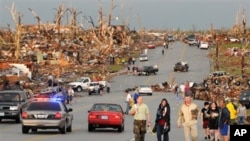
The powerful tornadoes and other extreme weather events that have cut swaths of destruction across the United States over the past month have prompted many to wonder if they are part of a new trend. Are these violent storms the result of climate change, or can they be explained as normal weather variations?
This has been a record year for tornadoes in the United States. North America seems to be especially hard hit.
"We have probably the most tornadoes when you think about the square mileage where we get them," says David Imy, operations chief at the National Oceanic and Atmospheric Administration’s Storm Prediction Center, "and also the more intense tornadoes and the reasoning happens to be the Rocky Mountains."
Watch related Suzanne Presto video report
According to Imy, the Rocky Mountain range prevents moisture from the Gulf of Mexico from spreading westward and forces it to concentrate over the midsection of the country.
"Also it gives us dry air aloft that comes in and makes it more favorable for severe storms and tornadoes," says Imy, adding that the more than 200 tornadoes in the past month alone is an anomaly, "… compared to many other years that we’ve looked at. It’s hard to say that there is any trend in what we’re seeing this year. And so far we haven’t seen any differences in other parts of the world."
But does the record U.S. tornado season have anything to do with global climate change?
"It is almost impossible for us to pinpoint these specific events...and say they were caused by climate change," says William Chamedies, an atmospheric scientist and dean of the Nicolas School of the Environment at Duke University. "On the other hand we do know that because of climate change those kinds of events will very, very likely become more common, more frequent, more intense. So what we can say is that these kinds of events that we are seeing are consistent with climate change. "
Those ideas underscore the findings of a National Research Council Report commissioned by Congress and released earlier this month. Chamedies, vice chairman for the report, says it warns that global warming is real and that action needs to be taken to limit its magnitude and prepare for its impacts.
"And, we don’t know exactly what is going to happen, but we know that we face risks," he says. "What are we going to do to manage those risks in making decisions that will minimize the likelihood that certain impacts will occur and also providing a sort of resiliency so that we adjust to those impacts if and when they do occur."
Chamedies says the lesson from the destructive storms in the United States is that, no matter how sophisticated forecasting technology has become, the nation must find ways to reduce its vulnerability to extreme weather events, whether or not they’re caused by climate change.